















































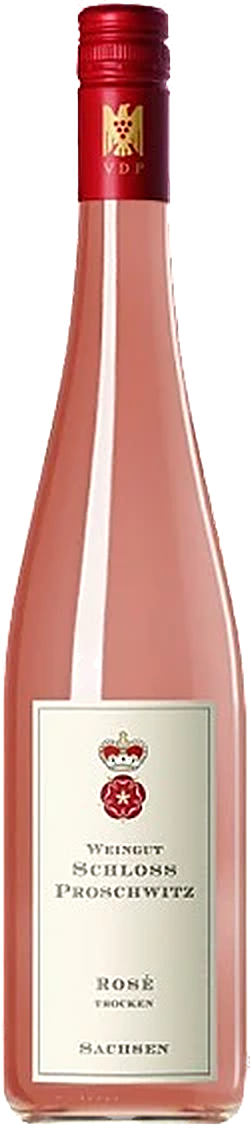
Proschwitz Castle Rosé

Red berries, clear acidity, mineral bite – Saxony's Elbe-Rosé with backbone.

Sale price15,90 €21,20 €/l 0,75 l

In stockDelivery in 1-2 working days
  • Free shipping from 99 €
  • 14-day right of withdrawal, return without giving a reason
Earn 16 points for every purchase of this product.
Sale price12,95 €17,27 €/l

Proschwitz Castle Rosé

A rosé with substance: not summery lightness at any price, but red berries, clear acidity and a finish with bite.

Schloss Proschwitz on the Elbe River is Saxony's oldest privately owned winery. Revived from its slumber after German reunification by Prince zur Lippe, it has been consistently developed over three decades. The vineyards around Meissen, situated on weathered granite and gneiss, give the wines their characteristic freshness and mineral depth—unusual for a German rosé.

In the glass, a vibrant acidity is evident, keeping the wine taut without being harsh. The bouquet opens with cool aromas of raspberry, red currant, and a hint of pomegranate. On the palate, it is juicy and direct, with a firm backbone that sets it apart from cottony rosé wines. The finish is long, mineral, and subtly spicy.

Serving suggestion: Best served at 10–12 °C. Pairs well with grilled salmon, goat cheese salad with walnuts, or a platter of cold cuts and olives. Also a solid choice as an aperitif on a long summer evening.

Grape variety Regent, Frühburgunder
Origin Saxony, Germany
Taste Dry
Alcohol 11,5 % Vol.
Serving temp. 10–12 °C
Volume 0,75 l
Country of origin Germany
Region Saxony
Grape variety Regent, Frühburgunder
Wine color Rosé Wine
Vintage 2025
Alcohol content 11,5 % Vol.
Taste Dry

In detail

How does the Schloss Proschwitz Rosé taste?

Dry, firm, and fruit-fresh: this rosé relies on structure instead of pleasantness. With 11.5% vol, it has body without seeming heavy.

The grape varieties Regent and Frühburgunder give it a red fruit with a bit more weight than you know from many light rosé wines. Regent is a fungus-resistant red wine variety and brings color and pull, while the Frühburgunder contributes the fine Burgundy fruit. The location in Saxony ensures a cool, clear tone. As a quality wine from the Elbe Valley, it thus differs from the softer, often sweetly rounded rosé wines that are common in this category. The screw cap keeps it uncomplicated to handle.

What does the Proschwitz Rosé pair with?

It pairs well with salad because its acidity picks up vinaigrette and freshness without the wine becoming thin. With seafood, the dry nature plays out its strength: it lets the fine sweetness of shrimp or mussels stand and provides a clear counterpoint with its freshness.

An antipasti platter with olives, cold cuts, and pickled vegetables gets along with the wine because acidity and body also catch salty and spicy notes. Serve it at 10–12 °C.

As an aperitif, it is suitable for summer evenings on the terrace and for the start of a meal with friends. It also has its place on mild early autumn days when you are still sitting outside and want something fresh in your glass.

Rosé wines similar to the Proschwitz Rosé

All three alternatives are dry rosé wines from Germany, but they come from other regions and rely on other grape varieties.

  • Hammel & Cie Der mit dem Rosé tanzt trocken comes from the Palatinate and combines five grape varieties, including Dornfelder and St. Laurent. It is the better choice if you are looking for a cuvée from several varieties.
  • Philipp Kuhn Philipps Rose also comes from the Palatinate and unites, among others, Cabernet Sauvignon, Merlot, and Blaufränkisch. It fits if you prefer a cuvée with international grape varieties.
  • Künstler Spätburgunder Rose from the Rheingau is a single-varietal Spätburgunder. Reach for it if you want a rosé from only one grape variety.

Quick answers

The Winery

Prinz zur Lippe

VDP Member Estate

The Prinz zur Lippe winery – the oldest winery in Saxony. After expropriation in 1945, it returned to family ownership in 1990 through Dr. Georg zur Lippe. Today, 70 hectares of vineyards with the best sites, Kloster Heilig Kreuz Meißen and Schloss Proschwitz. Granite and loess loam characterize the soils.

Elbling, Riesling, Pinot Blanc, Pinot Gris, and Goldriesling are grown – about 400,000 bottles annually.

The Proschwitz terroir gives the wines filigree acidity, fine aromas, and mineral fullness. A taste experience as individual as a fingerprint.

Diera-Zehren OT Zadelschloss-proschwitz.de

Similar products