Love as an act of foundation: Carmen Bickel, Reimund Stumpf and the 1976 vintage
The Weingut Bickel-Stumpf was established in 1976 when the then Franconian Wine Queen Carmen Bickel and the Thüngersheim master winemaker Reimund Stumpf married and simultaneously merged their two family estates. This union became more than just a joint business: Frickenhausen am Main and Thüngersheim — two villages, 35 kilometers apart along the Main, two completely different soils — formed a single unit from then on. The winery has been a member of the VDP since 1980. Today, two generations work side by side: Carmen and Reimund Stumpf as well as their son Matthias, who has taken over responsibility for the cellar and consistently continues the stylistic line.
Manual labor on limestone and sandstone — without an organic label, but with conviction
Matthias Stumpf puts it directly: The respectful use of nature's resources is a matter of course — no organic certificate is needed for that. The winery is a member of Slow Food and is committed to agriculture that respects the environment, biological diversity, and cultural identity. In the VDP.Erste and Grosse Lagen, the soil is partially worked by hand, and the harvest is carried out exclusively by hand with careful selection of the berries. The vinification of the higher-quality white wines takes place in Franconian wooden barrels — gently and without fashionable shortcuts. Silvaner dominates the 11.4-hectare estate with around 60 percent of the vineyard area; it is supplemented by Riesling, Müller-Thurgau, Pinot Noir, as well as Scheurebe and Traminer.
Two terroirs, two characters — Silvaner as the family language
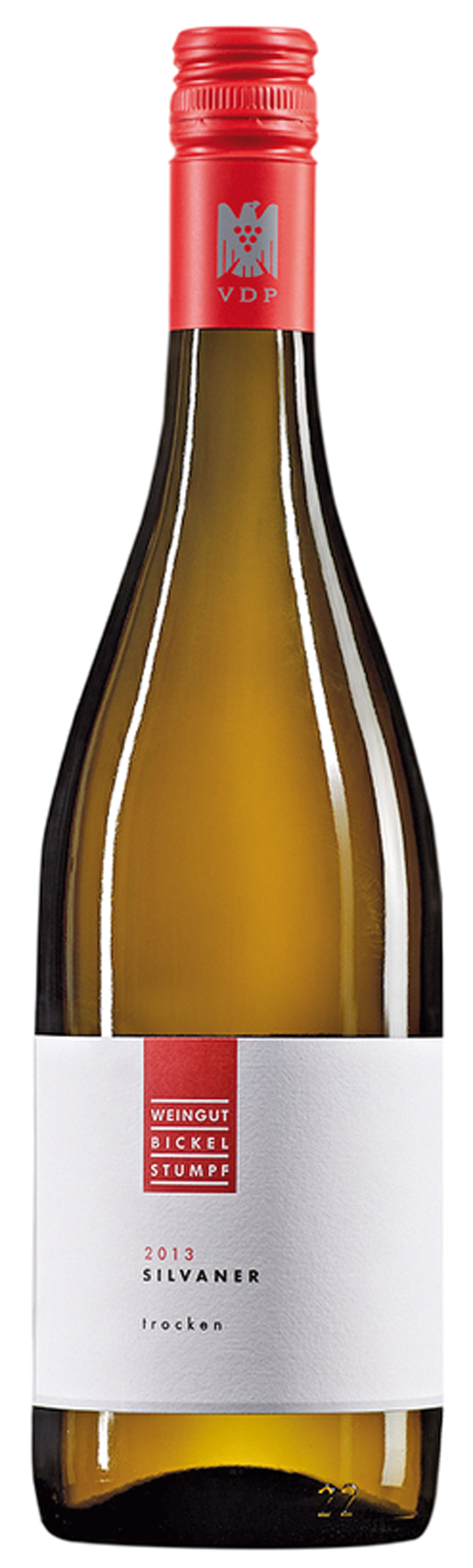
The key to understanding Bickel-Stumpf wines lies in the soil. On the edge of the medieval city wall of Frickenhausen, the Mönchshof site drops off as a barren shell limestone slope directly to the Main — a water protection area whose over 200-million-year-old terroir gives the Silvaners a creamy melt, body, and Burgundian elegance. The Grosse Gewächs from the Mönchshof is the pride of the house. In the Thüngersheimer Johannisberg, on the other hand, in a small side gully called Rothlauf, red variegated sandstone pushes to the surface: The wines from this parcel, also classified as a VDP.Grosse Lage, turn out filigree, straightforward, and mineral, with a length that stays in the memory. In addition, there is the Frickenhäuser Kapellenberg as a VDP.Erste Lage as well as a bottle-fermented Crémant from the Kapellenberg site — an artisanal sparkling wine that shows that the Bickel-Stumpfs certainly know how to appreciate the lightness of savoir-vivre. All wines, from the local wine to the Grosse Gewächs, are vinified in the Franconian dry style — under four grams of residual sugar, because it simply makes sense for Silvaner at this level.