From farming village to international reference for Burgenland red wine
The name Achs has been associated with viticulture in Gols since 1684 — at that time still embedded in a mixed agricultural operation where vines, arable land, and livestock belonged together. Paul Achs Junior, born in 1968, took over the family business in 1990 at just 22 years of age. Previously, he had worked in California, in the Russian River Valley at the Pat Paulsen Winery, and learned there how to produce red wines — especially Pinot Noir — with depth and structure. He brought this knowledge back to Gols and made a decision that was unusual at the time: he consistently converted an operation that was traditionally oriented towards white wine into a red wine winery. Since then, the area has grown from 12 to 25 hectares. The vines that his grandfather planted still bear fruit today.
Biodynamics as an attitude, not a marketing message
Since 2006, the winery has cultivated all areas biodynamically; since 2009, the operation has been organic-certified and a member of the Respekt-BIODYN group. Paul Achs himself describes the change not as a strategic decision, but as a necessary consequence: "I felt that conventional viticulture didn't really fit us." Today, clover species and buckwheat grow in the vine rows, the soil is alive, and the grapes have more character than before, by his own account. Exclusive hand-harvesting on all parcels is just as much a standard as minimal intervention in the cellar. The 25 hectares are spread over about 40 to 50 parcels — slopes at the transition of the Parndorfer Platte to the Seewinkel on one side, flat heathland on the other. The soils alternate between loess, black earth, gravel, sand, and heavy clay with limestone deposits. More than 2,000 hours of sunshine a year and the humid proximity of Lake Neusiedl shape the Pannonian microclimate, which Achs uses as a raw material — without overwriting it.
Paul Achs has also helped shape the region at the producer level: in the mid-1990s, he was involved in the founding of the Pannobile winemakers' association, which significantly sharpened the quality awareness in the Lake Neusiedl area.
Blaufränkisch in the center — an assortment with a clear origin pyramid
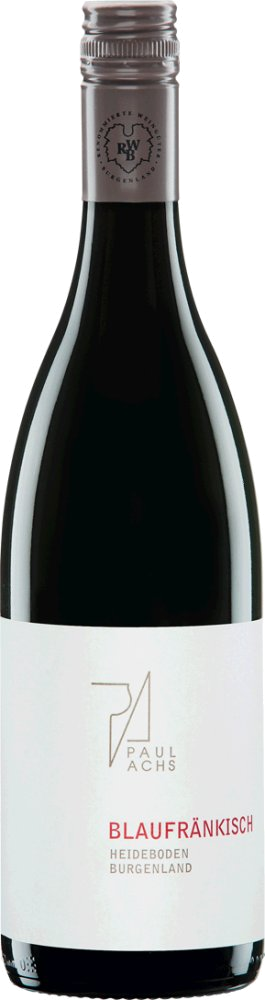
The focus is on local red wine varieties: Blaufränkisch — the dominant grape variety on about 10 hectares — Zweigelt, St. Laurent, and Pinot Noir. Added to this are Syrah as well as Chardonnay and Sauvignon Blanc on the white wine side. The assortment follows an origin pyramid: regional wines show the larger landscape area of Burgenland, village wines bundle several sites from Gols, and site-specific wines like the Blaufränkisch Ungerberg come from a clearly defined single vineyard and show the peculiarities of this soil without a detour. The top site Altenberg — with its SSW orientation one of the warmest in Gols — delivers Blaufränkisch with dense structure and mineral freshness on heavy clay soil with limestone. Typical maturation: fermentation in steel tanks, 18 months of maturation in used barriques and 500-liter barrels, followed by another 14 months in 1,200-liter barrels. The result is red wines with substance and drive — firmly anchored in the soil, without appearing heavy.