From the heart of Sicily: How a cooperative reinvented the wines of Sambuca
Cantina Cellaro was founded in 1969 by a group of local winegrowers in Sambuca di Sicilia, an old town in the province of Agrigento at the foothills of the Monti Sicani — known as Zabut since the Middle Ages, established by Arab settlers in the 9th century. Three years after its founding, in 1972, the cooperative began regular wine production. At that time, the member families pooled their knowledge and their grapes to ensure the economic survival of the entire region: Cellaro has literally helped shape the landscape of Sambuca — grain fields gave way to the green of the vines. A decisive step followed in 1980, when the winery began bottling its wines directly on-site instead of having the harvest vinified elsewhere. A strategic partnership with the Apulian wine group Farnese Vini finally brought fresh impetus: the range was revised, the cellar equipment modernized, and a systematic mapping project of the vineyard sites began.
Today, Cellaro bundles the harvests of several hundred member farms and cultivates a total area of over 1,500 hectares of vineyards — one of the most important cooperatives in Western Sicily.
Hillside location, marine sediment, and wind power: How Cellaro works with its terroir
The vineyards around Sambuca di Sicilia are located at an altitude of 300 to 700 meters — remarkably high by Sicilian standards. The soils consist of clayey marine sediments of the middle hillsides and give the wines a natural structure and freshness that contradicts the initial image of the sweltering hot island. The proximity to the sea on the southwest coast ensures cool nights, without which aromatic depth in Nero d'Avola or Nerello Mascalese would hardly arise. On the ridges around the winery, there are wind turbines that bring renewable energy to the region. In the cellar, oenologist Giuseppe Verde, who comes from Sambuca and was trained in Piedmont in the Barolo and Barbaresco area, is responsible for the oenological line; he works closely with Filippo Baccalaro. This combination of local roots and technical standards runs through the entire operation: from site selection and hand-picking to the classification of the best parcels for the respective wine lines.
Autochthonous grape varieties in focus: What to expect in your glass at Cellaro
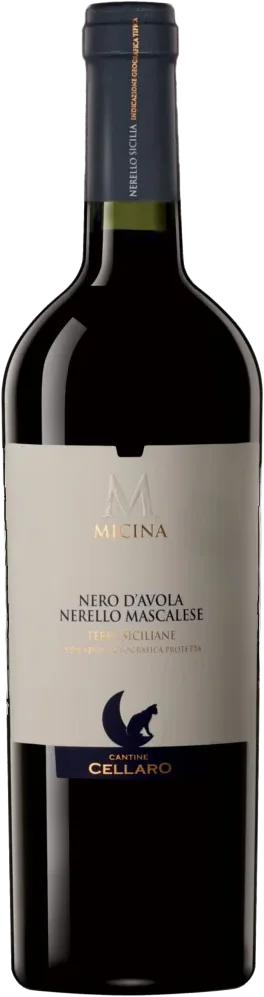
The heart of the range is formed by the native varieties of Sicily: Nero d'Avola and Nerello Mascalese for the reds, Grillo and Catarratto for the whites. The Due Lune — a cuvée of Nerello Mascalese and Nero d'Avola — represents the upper segment of the range and combines the dark fruit of Nero d'Avola with the lively acidity and berry aroma of Nerello. The Micina vinifies Nerello Mascalese as a single-varietal Terre Siciliane IGP: an accessible, balanced red wine that shows how much elegance this grape variety, native to Mount Etna, also possesses in the west coast interpretation. In addition, with the Lumà line, Cellaro produces white and red wines from Grillo, Chardonnay, Nero d'Avola, and Syrah, which are aged in oak barrels. The spectrum ranges from fresh everyday wines to award-worthy Cru bottlings — all under the DOC or IGP seal. Anyone looking for Sicilian viticulture with a genuine regional connection will find a clear answer at Cellaro: little international bending, lots of island.