Campania's oldest grape varieties, brought to the bottle anew
Vesevo was created in 2000 as a joint project between the Abruzzo-based house Farnese Vini — now known as Fantini — and local partners in Campania. The name is no coincidence: Vesevo is the ancient Latin name for Mount Vesuvius, the volcano that has shaped the landscape and viticulture of the region for millennia. Even the Romans appreciated the wines from the foot of Vesuvius on the tables of the patricians — until catastrophic eruptions caused the vineyards to disappear for centuries. Vesevo consciously builds on this buried tradition and brings Campanian grape varieties back into international attention.
Campania is one of the most biodiverse wine regions in the world, with more than 100 autochthonous grape varieties. Vesevo focuses on exactly these regional character varieties — Falanghina, Greco, Fiano, and Aglianico — and works with around 60 hectares of vineyards on volcanic, mineral-rich soils. In the hinterland of Vesuvius, where day-night temperature differences ensure slow, aromatically dense ripening, lie the foundations for the characteristic range.
Volcanic soil, local knowledge, Tuscan precision in the cellar
Vesevo benefits from two worlds: the deeply rooted terrain knowledge of local Campanian winegrowers and the cellar-technical know-how of the Fantini Group, which, with its network of several wineries across southern and central Italy, is one of the most experienced producers in the country. The vinification is accompanied by Alberto Antonini, a renowned Tuscan oenologist who sharpens the stylistic signature. In the cellar, Vesevo relies on modern technology without domesticating the character of the old grape varieties. For Taurasi, for example, an extended maceration is followed by maturation in oak barrels — in accordance with the DOCG appeal, which prescribes at least three years of aging, one of which in wood.
Autochthonous grape varieties that do not deny their origin
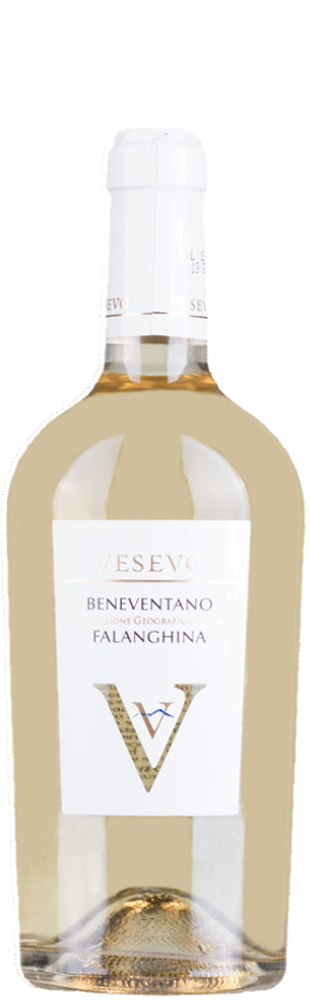
The Vesevo range can be divided into two clear character profiles. The white wines — Falanghina Beneventano and Greco di Tufo DOCG — show what volcanic tuff soil and Mediterranean sun can get out of old Campanian varieties: fresh fruit, floral notes, a lively acidity, and the typical mineral undertone that goes back to the tuff and lava soils around Avellino. On the red side, the Aglianico Beneventano is the accessible entry — intense in dark fruit, with soft tannins and a spicy finish. The highlight is the Taurasi DOCG, Campania's best-known red wine appellation, occasionally referred to as the "Barolo of the South": Aglianico from volcanic slopes in the province of Avellino, with firm tannin structure, notes of black cherry, licorice, and subtle mineral depth that lingers on the palate. Anyone who wants to understand Campanian wine culture will find a clear, artisanally solid entry at Vesevo — from fresh white wine to serious red wine with substance.