Behind the walls of Montepulciano: Luciano Scaccini's Tenuta San Salvagio
Tenuta San Salvagio is located immediately below the historic city walls of Montepulciano, on a side with a view of the Val d'Orcia and the Valdichiana — and thus in the middle of one of the most traditional wine landscapes in southern Tuscany. The company was founded in 1996, when Luciano Scaccini acquired the Tenuta and began viticulture there under his own management. The winery itself is a testament to this rootedness: only materials from old Tuscan farmhouses were used for the construction, which gives the building a character that clearly stands out from modern functional buildings. Scaccini runs the business as an Azienda Agricola — as an agricultural family estate — and is present by name as a winemaker on every label.
Ten hectares of Sangiovese on clay and tuff
The heart of the winery is around ten hectares of vineyard area on the individual sites of Pietrose, Spinella, and Colombelle. The soils consist of clay and tuff-containing material — a combination typical for Montepulciano, which gives the Sangiovese (known here by the local name Prugnolo Gentile) structure and a characteristic mineral note. The stocks are supplemented by small proportions of Cannaiolo and other autochthonous varieties, as provided for by the DOC and DOCG regulations for the region. In the cellar, San Salvagio relies on classic aging in Slavonian oak barrels: the Rosso di Montepulciano matures for six months in wood, the Vino Nobile undergoes barrel aging of 24 months, followed by six months of bottle aging. Technical interventions such as fining are deliberately avoided in order to preserve the natural structure of the wines.
Three wines, one style: depth from the Prugnolo Gentile
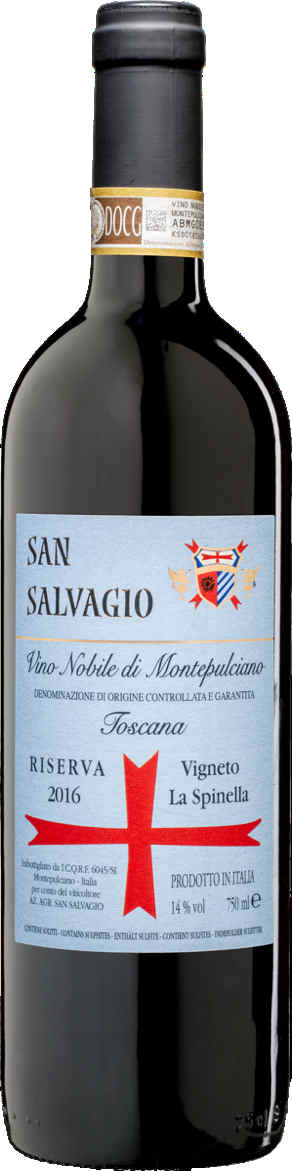
The range of San Salvagio follows the classic hierarchy of the appellation. The Rosso di Montepulciano DOC is the most accessible entry: spicy, with lively fruit, pleasantly tannic, and suitable for everyday use. The Vino Nobile di Montepulciano DOCG shows what the Pietrose and Spinella sites can get out of the Prugnolo Gentile — aromas of ripe plum, cherry, and violet, a powerful yet balanced body, fine tannins, and a long finish. The Riserva DOCG requires an aging period of at least three years according to the regulations of the appellation and shows correspondingly more depth, spice, and complexity. All three wines go well with roasts, game, and aged cheese — anyone who serves them is moving on tonally setting Tuscan terrain in culinary terms.