Declaration of love to Sardinia: How Gavino Sanna founded Mesa
Cantina Mesa was created in 2004 from a clear idea: advertising expert Gavino Sanna, one of Italy's best-known creatives, wanted to translate his Sardinian home into bottles. Not with imported concepts, but with the grape varieties, soils, and winds of the island's extreme southwest. The name Mesa — "table" in both Sardinian and Spanish — summarizes this ambition in four letters: community, hospitality, sharing a meal. The winery is located in the Contrada Su Baroni near Sant'Anna Arresi, above the Porto Pino valley, with a view of the gently sloping hills towards the coast. Since 2017, Mesa has belonged to the Santa Margherita Group and is now part of the Herita Marzotto Wine Estates, but has consistently maintained the profile and signature of the region.
Gravity instead of pumps: Architecture and viticulture as a system
The cellar building is no coincidence: the three-story, white-plastered facility with its minimalist design language was conceived from the ground up for gravity-fed vinification. Delivered grapes reach the fermentation tanks from above without the use of pumps — from delivery to the start of fermentation, the house works with the gradient. The aging cellar is located underground, laid out in an almost circular shape, and is kept at a constant temperature. Here, the wines mature in barriques, tonneaux, and cement vats.
In the vineyard, Mesa consistently avoids herbicides, pesticides, and fungicides. This is made possible to a large extent by the terroir itself: the Mistral, which blows permanently through the Sulcis, dries the foliage, keeps fungal diseases at bay, and at the same time gives the grapes that salty note that is characteristic of the wines of the extreme south of Sardinia. The soils change in small areas between aeolian sandstone over limestone and clay-loamy zones with a high calcium and micronutrient content — rich in structure despite the high sand content, perfectly suited for the old Carignano vines that root deeply here and survive drought without irrigation.
Carignano and Vermentino: the Sulcis profile in the glass
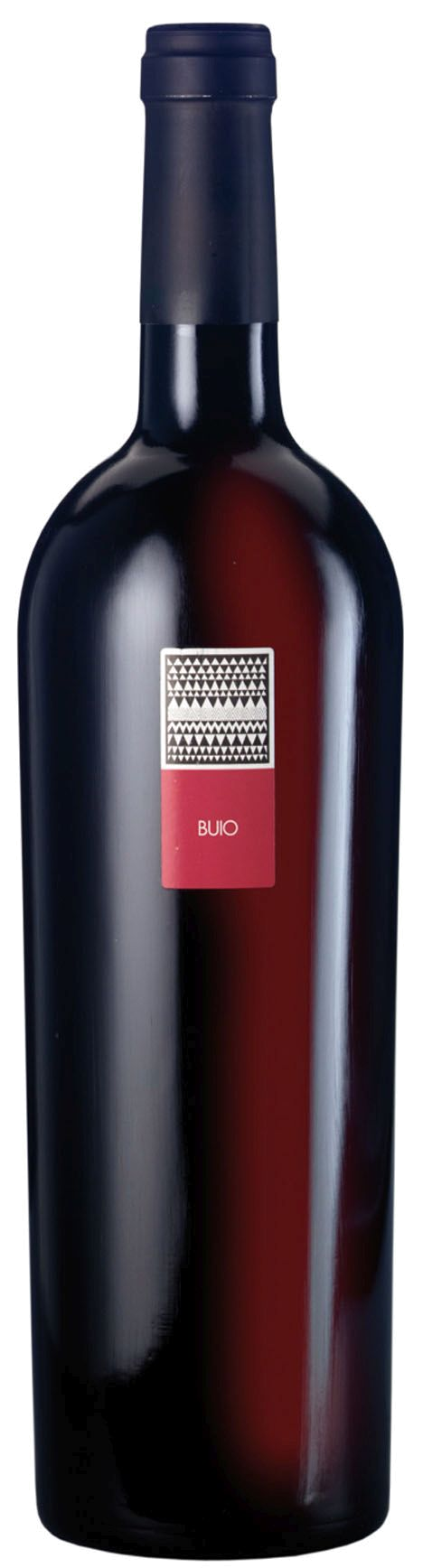
Two grape varieties define the range: Carignano del Sulcis and Vermentino di Sardegna. The Carignano — often present in the Sulcis as ungrafted old vines in the alberello training system — does not produce heavy, phenolic red wines in this climate, but rather wines with dense fruit, Mediterranean herbs, and lively acidity. The Buio Carignano del Sulcis DOC stands for this accessible, aromatically clear side of the grape variety; the Riserva Buio Buio, selected from the oldest plots, extends maceration and wood aging and shows the more concentrated, structured face. The Giunco Vermentino di Sardegna DOC comes from the same coastal climate: citrus, salty mineral tones, taut acidity — a white wine that directly reflects the maritime terroir. In addition, there are other lines under the Isola dei Nuraghi IGT as well as the Cannonau di Sardegna, which complement the broad aromatic spectrum of the island.