Deeply rooted in the Maremma: the Antinori family and Le Mortelle
The Marchesi Antinori are among the oldest winegrowing families in Italy—since 1385, when Giovanni di Piero Antinori joined the Florentine Wine Guild, the craft has been in the family. The fact that they are no strangers to the Maremma is proven by a property register from 1863, which identifies Poggio Franco—today one of the estate's best single vineyards—as Antinori property. However, the actual winery history of Le Mortelle began in 1999, when the family acquired the former fruit estate near Castiglione della Pescaia in the province of Grosseto and specifically converted it into a winery. At that time, the Maremma was still an outsider in the Italian wine scene—the DOC Maremma Toscana was only created in 2011—and that was exactly what appealed to the Antinoris: a coastal landscape with significant, barely tapped potential.
Le Mortelle takes its name from the mortella, the wild myrtle shrub that is widespread on the Tuscan coast and became the symbol of the estate. The property now covers 270 hectares, around 175 hectares of which are planted with vines.
A cellar in the hill: gravity-fed vinification and organic farming
The new construction of the wine cellar was aimed at minimal intervention in the landscape from the beginning. The facility is built predominantly underground into the hill and works consistently according to the gravity principle: grapes and wine flow from level to level without pumps—from the receiving hall through the vinification room to the barrel storage hall on the lowest floor. Natural materials and the thermal mass of the rock regulate the temperature, which significantly reduces energy consumption. In addition, there is a water cycle that relies on phyto-remediation: a filtration process using volcanic rock, plants, bacteria, and algae.
Le Mortelle farms organically in the vineyard. Precise plant protection, green manure, and targeted cover cropping of the rows are intended to preserve the ecosystem and limit interventions to what is necessary. The sandy, loamy-clay soil mosaic with partial rock content ensures natural stress regulation of the vines and good drainage—a terroir that gives contour to both powerful Bordeaux varieties and aromatic white wine varieties.
Between coastal salt and barrique: the Le Mortelle range
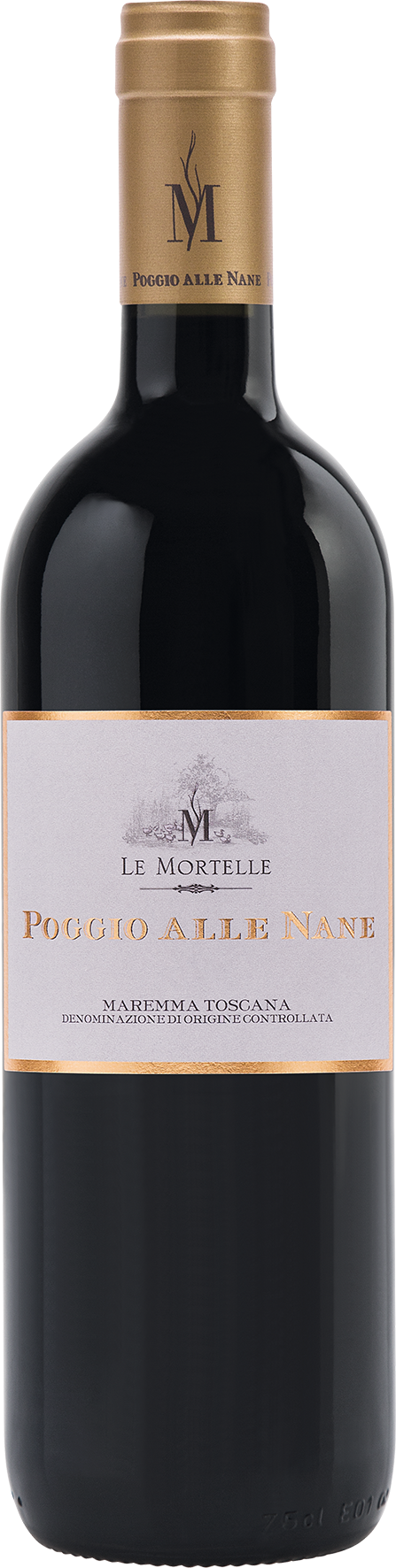
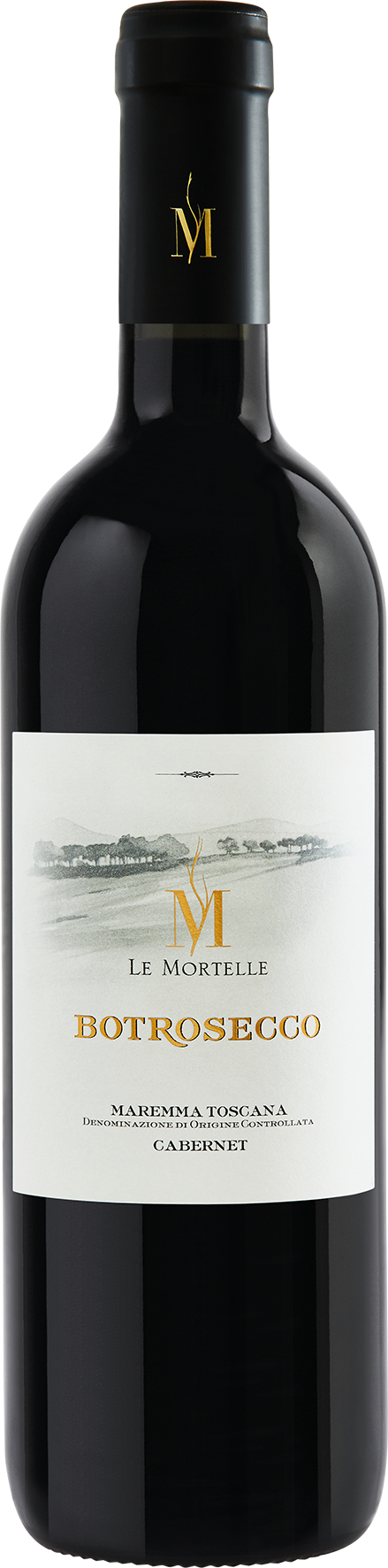
The vineyard area is planted with Cabernet Sauvignon and Cabernet Franc, supplemented by a small Carménère plot for the red wines, as well as Vermentino, Ansonica, and Viognier for the white wines. The flagship Poggio alle Nane is a cuvée of Cabernet Franc, Cabernet Sauvignon, and Carménère that combines the structural power of Bordeaux varieties with the mineral-saline character of the coastal Maremma and matures in barriques. The Botrosecco works with the same grape varieties and, after twelve months of barrel aging, shows notes of dark berries, mint, and spices with a robust body. As a more accessible entry, the Ampio stands for the fruit-forward, direct red of the house. On the white side, the Vivia—a blend of Vermentino, Ansonica, and Viognier, after a short period of yeast aging in stainless steel tanks—brings the aromas of the coast into the glass: pear, citrus zest, orange blossom, and a salty, spicy finish. The range thus spans a clear arc from fresh everyday wine to age-worthy, terroir-focused red wine.