Four centuries of wine history on the edge of the Via Agrippa
Château Maucoil is one of the oldest wineries in the southern Rhône. The site was inhabited as early as antiquity — its location on the Roman trade route Via Agrippa and a natural spring made the plateau a coveted location. In 1624, Joseph de La Pise, Lord of Maucoil and archivist of the House of Orange-Nassau, built the château at the behest of Prince Maurice of Orange and gave the estate its name. Since then, viticulture has been inextricably linked with Maucoil: in the 17th century, several winemaking families took over the tradition, and in the 20th century, the Goguet de la Salmonière and Quiot families shaped the estate. In 1995, the Arnaud family — already known as the owners of Château Cabrières — acquired the property and initiated its modern era. Since 2022, Jean-Philippe Girard, also owner of Domaine Chantal Lescure in Burgundy, has been writing the next chapter of this long history together with Bernard Duseigneur from the biodynamically managed Domaine Duseigneur.
Biodynamics, old vines, and three soil types
The winery manages 25 hectares in the Châteauneuf-du-Pape appellation and 18 hectares in the Côtes du Rhône Villages appellation, spread across the municipalities of Châteauneuf-du-Pape, Orange, and Sorgues. The vineyards lie in a contiguous block. The estate began the transition to organic farming in 2011, and full organic certification followed in 2014 — today, all 45 hectares are managed organically, and biodynamic methods are also incorporated into the work. Chemical herbicides are not used; instead, the focus is on traditional soil care through furrowing, hilling, and plowing. Manure and algae preparations serve as fertilizer.
The vines grow on three clearly distinguishable soils: red clay subsoil at the core of the estate, where the roots reach up to three meters deep, hard limestone rock in the west, and sandy slopes in the east, which were formed by the retreat of the Rhône. In addition, there is the Villafranchian plateau belt — the highest point of the appellation — with a layer of rounded galets over a subsoil of safres. Most of the vines are between 60 and 80 years old; the oldest plot, at the foot of the château, was planted shortly after the phylloxera crisis in 1895 and is still cultivated today.
All 13 grape varieties of Châteauneuf-du-Pape — palpable in the glass
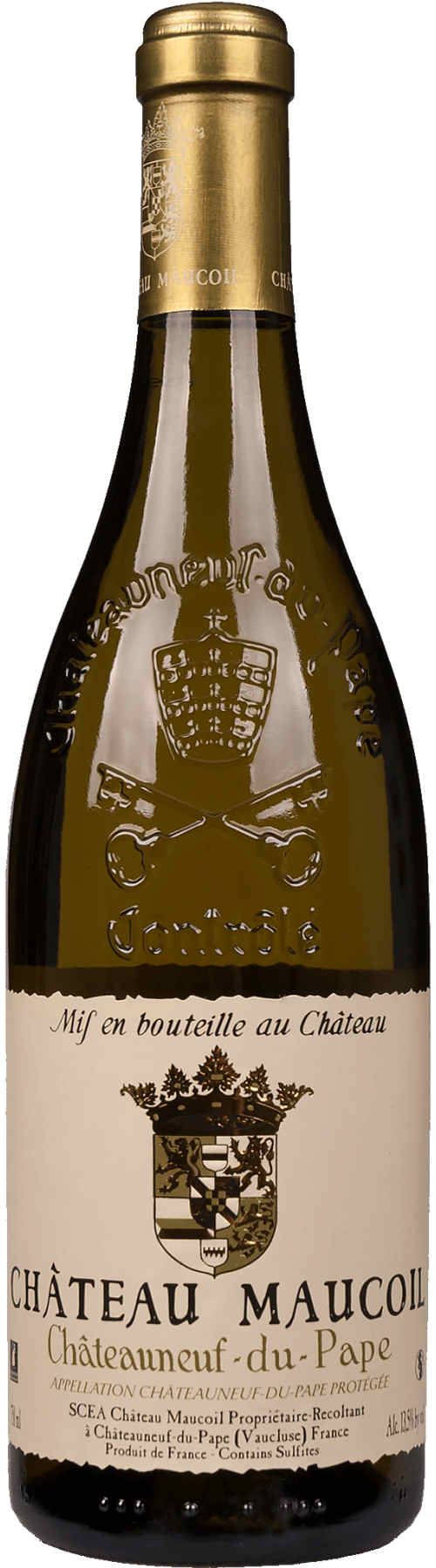
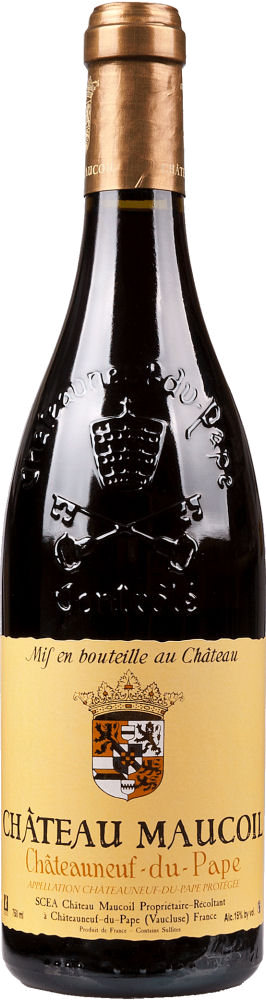
What positions Maucoil particularly well within the appellation: the estate is one of the few that maintains and vinifies all 13 grape varieties permitted in Châteauneuf-du-Pape — Grenache, Syrah, Mourvèdre, Picpoul, Roussanne, Clairette, Bourboulenc, Muscardin, Picardan, Counoise, Cinsault, Terret Noir, and Vaccarèse. Grenache dominates with around 70 percent, followed by Syrah and Mourvèdre. This variety, combined with the diversity of the soils, enables cuvées of true complexity: depending on the plot and aging, with an emphasis on depth and structure or on fresh aromatics. The harvest is done by hand, the grapes are transported in small crates and sorted plot by plot before crushing. For the white wines — including the Châteauneuf-du-Pape Blanc — Grenache Blanc and Clairette are vinified separately in stainless steel without malolactic fermentation to maintain freshness and balance. The red Châteauneuf-du-Pape wines mature in wooden barrels, with older cuvées coming from the estate's oldest vines and bringing correspondingly more concentration. Serving temperature red: 16–18 °C, white: 10–12 °C.