Four Caves, one territory – Founding a cooperative union in the Hérault
The Vignerons de la Vicomté is not a single winery, but a union of four cooperative cellars in the Hérault: Les Trois Grappes in Le Pouget, Clochers et Terroirs in Puilacher, the Cave de Saint Bauzille de la Sylve, and Les Vignerons de Soubergues in Saint Pargoire. Founded in 1977 as the Union de Coopératives Vinicoles, these four Caves joined forces to market their wines together – primarily for export. Their territory lies between Montpellier and Béziers, in the historical heart of the Languedoc, where viticulture has been practiced for more than two thousand years. Around 45 villages belong to the catchment area of this community, with vineyards extending over more than 7,500 hectares along the Hérault river.
The soils are as diverse as the hilly landscape itself: limestone-rich slopes, river alluvium, and the characteristic gravel terraces from the Villafranchian period alternate. This results in the AOP Languedoc, IGP Pays d'Oc, and the IGP Vicomté d'Aumelas appellations – a territorially clearly defined, little-known designation of origin that La Vicomté represents with conviction.
Sustainability as a structural decision, not a marketing promise
Since the 1980s, the affiliated winemakers have been working together on sustainable cultivation methods. This is not a commitment of recent years, but lived practice: 65 percent of the vineyard area today carries the HVE3 (Haute Valeur Environnementale) certification, a portion of the sites is organic-certified, and Terra Vitis is also part of the certification portfolio. In the cellar, the union's oenologists control the entire value chain – from grape to bottle – thus ensuring seamless traceability.
Since 2015, an agro-ecological program has also been running, supporting winemakers in changing their practices: greening of vineyard rows, reduction of inputs, and the creation of hedge structures as part of the Biodiv'eau project to protect the Laumède water catchment area. In parallel, the union is investing in climate-resistant grape varieties – including Souvignier Gris, Floréal, and Artaban – in collaboration with the INRAE research institute in Montpellier. Energy consumption and water resources are optimized cooperatively, and excess process water is treated and repurposed.
Grape variety breadth, Mediterranean climate, clear style
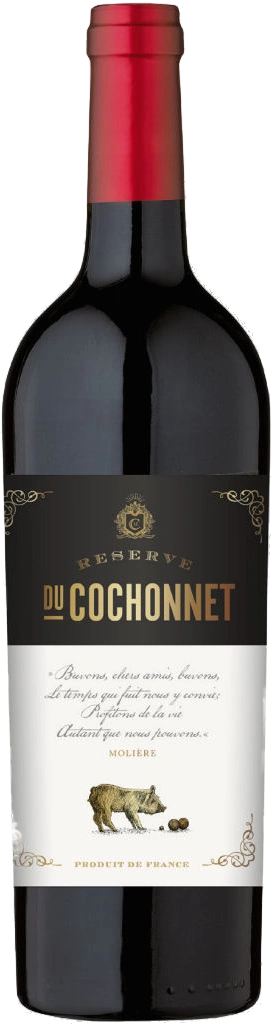
The Mediterranean climate of the Hérault brings plenty of sun, dry summers, and Tramontane winds that ensure healthy grapes. La Vicomté utilizes these conditions with a broad spectrum of grape varieties: on the red side, there are Grenache noir, Syrah, Merlot, Cinsault, Carignan, and Cabernet-Sauvignon; on the white, Chardonnay, Sauvignon blanc, Viognier, Grenache blanc, and Clairette. This diversity allows for both varietal single-varietal wines and complex blends. Around six million bottles leave the union's cellars annually – the majority of which go to export. The wines stand for directness and drinkability: fruity, lively, without exuberance – the result of artisanal oenology that puts the terroir in the foreground instead of over-shaping it. Our range includes, among others, the Réserve du Cochonnet Rosé and a Pays d'Oc – both typical representatives of this down-to-earth, Southern French style.