From Saint-Hilaire-Saint-Florent to the world: the founding history of Langlois
Everything began in 1885 in Saint-Hilaire-Saint-Florent, a small town just outside the gates of Saumur, which was already considered the center of the Méthode traditionnelle outside of Champagne at the time. Édouard Langlois, a young winemaker and merchant, and his wife Jeanne Chateau took over the former Maison Delandes there — their surnames combined to create the name Langlois-Chateau. Their goal: to create a fine sparkling wine that does justice to the soil of the Loire. With the support of the Baron de Bodman, who opened the cellars and grounds of the Château de Saint-Florent to them, they succeeded quickly. When Édouard fell in the First World War, Jeanne continued to lead the Maison with determination, supported by her son Alexis and her nephews. In 1973, the Champagne family Bollinger joined as owners — attracted by the unique location, the heritage, and the artisanal precision of the house. Under the long-standing leadership of Michel Villedey and, from 2008, François-Régis de Fougeroux, Langlois grew into one of the most well-known names in Loire sparkling wine. Since the end of 2023, the house has operated under the sleeker name Langlois — the initials "LC" in the coat of arms continue to commemorate Jeanne Chateau.
Tuffeau cellars, six terroirs, and strict self-discipline
Langlois manages around 95 hectares of its own vineyards, distributed across the best appellations of the Val de Loire: Saumur, Saumur-Champigny, and Sancerre. For the Crémants, the house sources grapes exclusively from six defined terroirs — Côtes de Saumur, Coteaux de Saint-Léger, Puy-Notre-Dame, Bas Layon, Haut-Layon, and Montreuil-Bellay — on soils of slate, limestone, and tuffeau. Langlois treats these plots internally like independent Crus. Hand-harvesting is mandatory, and the grapes are vinified by variety and by terroir. In the cellar, work takes place in vaults carved deep into the tuffeau, which provide constant temperature and humidity — ideal conditions for long aging on the lees. The Maison relies on lees-aging times that are sometimes significantly higher than the requirements of the Crémant de Loire appellation and even exceed the Champagne AOC standards. In the vineyard, an integrated pest management approach is followed.
Fine perlage, clear structure: what distinguishes Langlois Crémants
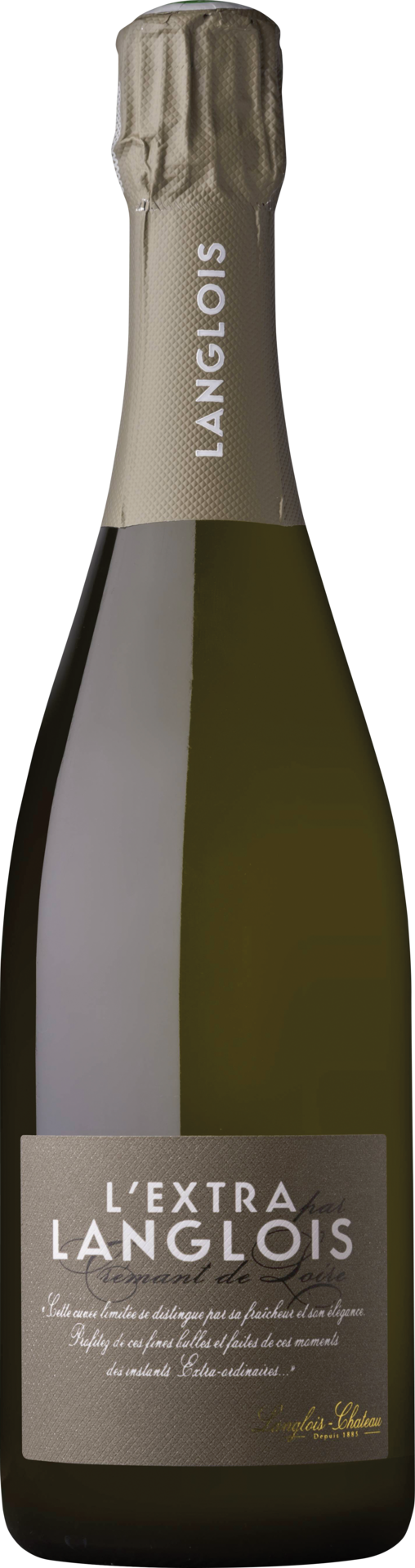
The heart of the range is the Crémants de Loire, made from Chenin Blanc, Chardonnay, and Cabernet Franc. Chenin Blanc provides the structure and the characteristic freshness, Chardonnay adds texture, and Cabernet Franc brings floral depth. The long lees-aging — at least 24 months for the standard Brut — defines the style: fine, creamy perlage, notes of brioche and white stone fruit, a dry, cleanly drawn finish. The Blanc de Blancs focuses entirely on Chenin Blanc and Chardonnay and emphasizes the mineral side of the tuffeau terroir. With the Clos Saint-Florent Saumur Blanc, Langlois shows that Chenin Blanc from this location — directly below the estate buildings with a view of the Loire — can also develop weight and length as a still wine. The range extends from the accessible entry-level Brut to the artisanally complex Cadence Extra Brut cuvée, which almost completely avoids dosage and brings the purity of the terroir to the fore.