From the Dauphiné to the whole world: the history of a winegrowers' union
The name Cellier des Dauphins is no coincidence: it refers to the historic Dauphiné, that southeastern French region that once belonged to the crown princes of France – the Dauphin – as a fiefdom. Founded in 1965 in Tulette, in the heart of the Côtes-du-Rhône wine-growing region, the project emerged from a simple but effective impulse: a group of winegrowers wanted to join forces to market and further develop the fruits of their soils together. What began as a union of a few cooperatives from the Drôme is today the largest winegrowers' association in the Rhône Valley – officially known as the Union des Vignerons des Côtes du Rhône. Today, 13 member cooperatives belong to the union, representing around 2,300 winegrowing families. The association is still based in Tulette, where the bottling plant and administration are also located.
Collective responsibility: Viticulture, cellar and environment
Cellier des Dauphins and its member wineries cultivate around 12,500 hectares of vineyards, which stretch from the southeastern Rhône Valley to the foot of Mont Ventoux. The sites grow on a variety of soils – sand, limestone, and alluvial layers – shaped by the Mistral and the intense sun of southern France. Vinification is decentralized in the individual member cellars; bottling and quality control are handled centrally via Tulette.
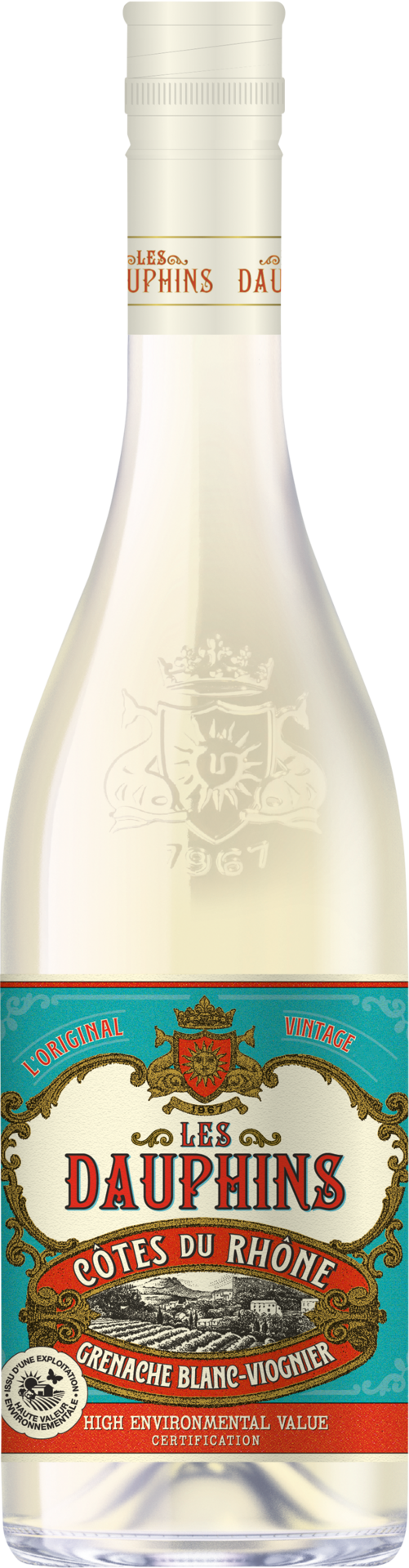
The union showed its colors early on when it came to sustainability: Since 2009, Cellier des Dauphins was the first Côtes du Rhône brand to offer an AOC line from certified organically farmed vines. In the meantime, over 1,350 hectares of the vineyards have been converted to organic farming – this is the largest contiguous organic vineyard area in the Rhône Valley. The winery team actively supports every conversion: three years of technical and financial support during the conversion phase are standard. At the same time, the union has reduced its ecological footprint in the cellar: lighter bottles, FSC-certified paper, vegetable-based printing inks on the labels, solar power, and a recycling rate of up to 90%. In 2020, Cellier des Dauphins won the first eco-design competition of the French recycling agency Adelphe – proof that packaging thinking here is not just cosmetic, but part of the corporate philosophy.
Grenache, Viognier and the character of the southern Rhône Valley
The range includes red, white, and rosé wines across around twenty appellations – from the basic Côtes-du-Rhône to cru wines from villages like Vinsobres or Cairanne. In the cellar, Cellier des Dauphins focuses on a modern, fruit-driven style: the focus is on freshness, accessibility, and the clear expression of the terroir, not weight or extraction. For the red wines, Grenache, Syrah, and Mourvèdre form the backbone – supplemented by Carignan and Cinsault, which contribute texture and spice. For the white wines, Viognier plays a central role: in this climate, the variety expresses its typical florality and fullness particularly clearly. The grapes are partly harvested at night or in the early morning hours to ensure freshness; vinification on the lees supports depth and structure. With wines distributed in around fifty countries and totaling more than 40 million bottles annually, Cellier des Dauphins is not only the largest but also one of the best-known ambassadors of the Côtes du Rhône worldwide.