From privateer heritage to Quatrième Grand Cru Classé
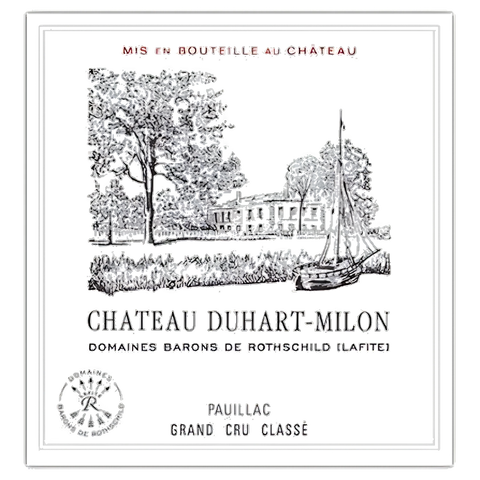
The name Duhart-Milon goes back to two sources: the hamlet of Milon in the north of Pauillac and a man named Sir Jean Duhart – a privateer under Louis XV who settled in Pauillac after a long career at sea and married Suzanne Castéja, heiress of an important Bordeaux family, in 1778. His house at the port of Pauillac inspired the label of the Grand Vin, which still commemorates this history today. As early as the beginning of the 18th century, the vineyards on the Milon hill supplied grapes for the second wine of Château Lafite – an early testament to the terroir quality that found official recognition in 1855: The classification elevated Duhart-Milon to the only Quatrième Grand Cru Classé of the Pauillac appellation.
After changeable decades – five owners in about 25 years, frost damage in 1956, a vineyard area that had shrunk to 17 hectares – the Rothschild family bought the Château in 1962. Since then, Duhart-Milon has belonged to the Domaines Barons de Rothschild (Lafite), the same house that is responsible for Château Lafite Rothschild, Château Clerc Milon, and other estates. Since 2018, Saskia de Rothschild has been running the family business in the sixth generation.
Precise viticulture on the cool Milon hill
The vineyard area now covers 76 hectares, which lie in a largely contiguous block on the west side of Château Lafite Rothschild – a rarity in the parcel-fragmented Médoc. The soil is a combination of fine gravel and aeolian sand over a tertiary limestone subsoil; in contrast to some neighboring sites, the more northerly exposure ensures a somewhat cooler microclimate, which allows for later harvest dates and gives the aromatics freshness. 67 percent Cabernet Sauvignon and 33 percent Merlot are planted, with a vine density of 7,500 vines per hectare.
The cellar work is carried out by the same vineyard and oenology team as at Château Lafite Rothschild – since 2020 under the concentrated focus of Technical Director Éric Kohler, who has since directed his activities exclusively to the group's two Pauillac estates. The aging follows classic Médoc principles: regular racking, maturation in barriques from the in-house cooperage with Allier and Nevers oak that has been air-dried for 24 months. In 2020, new cellars were completed, modernizing the infrastructure without affecting the characteristic style of the Château. Work in the vineyard includes the use of greening strategies in clay-rich parcel sections to structure the soil and control nitrogen inputs.
Structured depth with its own character
Within the Rothschild family, Duhart-Milon is considered the idiosyncratic neighbor of Lafite – earthier, edgier in its youth, with a sinewy tannin structure that gives the wine its unmistakable frame. The aromatics of the Grand Vin move between dark berries, cassis concentrate, graphite, and pencil shavings, underscored by floral notes and the tart minerality of the gravel soil. The Merlot portion brings melt and center, the Cabernet Sauvignon provides length and structure. Younger vintages show how more precise work in the vineyard and the warmer climate make the wines more accessible without giving up their characteristic independence.
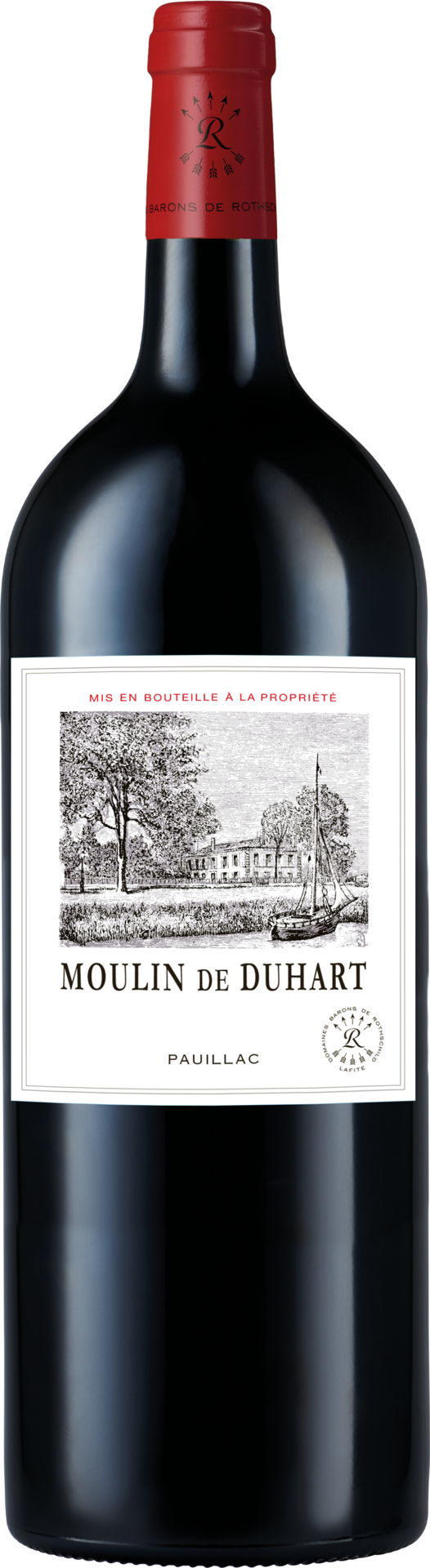
In addition to the Grand Vin – Château Duhart-Milon Pauillac Grand Cru Classé – the Château produces a second wine with Moulin de Duhart, which shares the same terroir origin but is accessible earlier and offers a more uncomplicated entry into the house style. Both wines are suitable for classic Bordeaux accompaniments: rack of lamb, mature beef, duck breast, or strong hard cheeses from the southwest of France.