From a medieval castle hill to one of the oldest wine domains of the Médoc
The history of Château Castera reaches far back into the time before classic Bordeaux. A manuscript from 1121, kept in the Tower of London, mentions the Castera fortress — at a time when most estates in the Médoc did not yet exist. The medieval complex in Saint-Germain-d'Esteuil, north of Saint-Estèphe, changed owners over the centuries: Étienne de La Boétie, Thomas de Montaigne, and his brother, the philosopher Michel de Montaigne, are among the recorded owners. When Anthoinette de Montaigne, Dame d'Arsac et du Castera, had a wine sale of 380 Livres Tournois notarized on January 21, 1616, one of the oldest written wine sales acts in the entire Médoc was created — the original is now in the square tower of the Château.
In 1986, German investors Dieter Tondera and Carl E. Press acquired the then-neglected estate and started a comprehensive restoration. Since 2010, Thomas C. Press, son of the co-founder, has been running the Château as the sole owner. Under his leadership, the medieval tower was converted into an archive room that makes the domain's private documents publicly accessible.
Two soils, a commitment to responsible viticulture
The winery comprises 63 hectares of vineyards, spread across the municipalities of Saint-Germain-d'Esteuil and Ordonnac, embedded in a total area of around 120 hectares with forest and natural areas. The vineyard lies on two clearly different soil types: Argilo-calcaire — clayey limestone — provides structure and body, while the Pyrenean gravel soils (graves pyrénéennes) promote finesse and elegance. The average vine is 27 years old; the oldest plot was planted in 1930. Pruning is done in the classic double Guyot system between November and March.
The vineyard work follows the principles of agriculture raisonnée — cultivation with the goal of minimizing the use of pesticides and preserving the biodiversity of the extensive domain grounds. In the cellar, cellar master Philippe Grynfeltt works with controlled temperatures and variety-specific vinification processes: for the red wines, extraction is gentle via pumping, and the Blanc de Blanc is aged sur lie in barrels for four months and stirred regularly on the lees.
Classic Médoc meets historic white wine — the Castera range
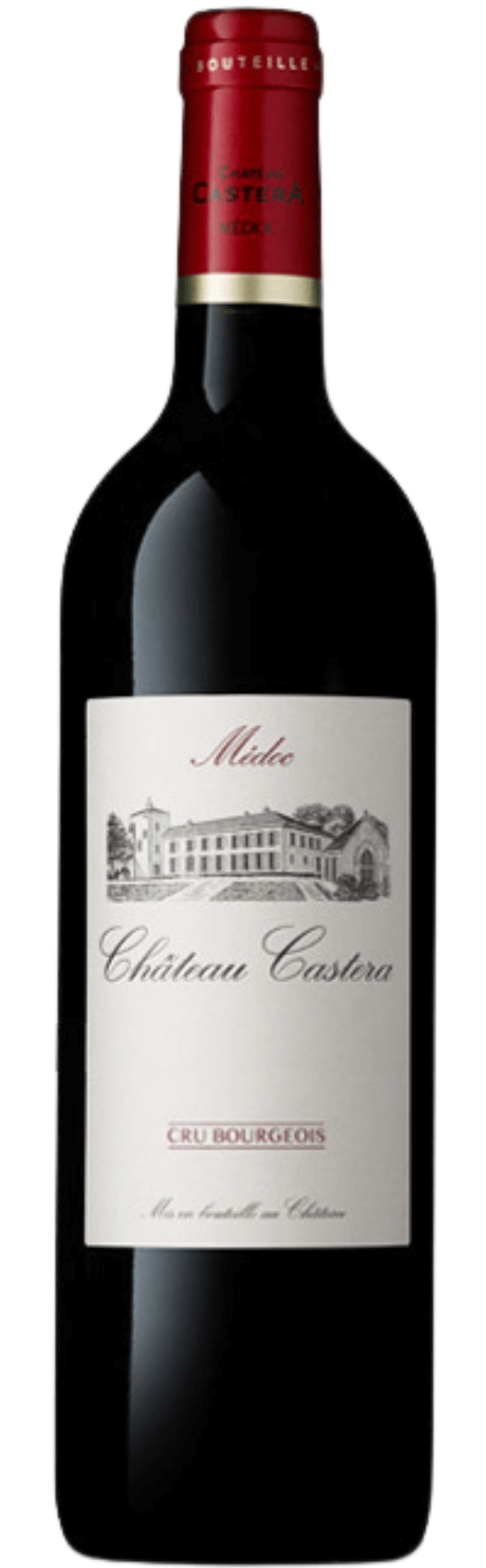
In February 2025, Château Castera was elevated to the rank of Cru Bourgeois Exceptionnel — the highest level of the Médoc classification for Crus Bourgeois. The heart of the range is the classic Médoc red wine: Bordeaux grape varieties on gravel and clay, with the structure and potential expected from this appellation.
Alongside this is the Anthoinette cuvée, a 100% Sauvignon Blanc — a conscious reminiscence of the tradition of Médoc white wines and, by name, a tribute to Anthoinette de Montaigne, the first female owner who signed the historic wine sales act in 1616. Four months of barrel aging with bâtonnage give the wine fullness without slowing down its freshness. The offer is complemented by the younger Cap Castera line, which is shaped by the next generation of the house and includes, among others, a Blanc de Noir from Cabernet Sauvignon and Merlot as well as a varietal Petit Verdot — wines that show how much scope the terroir of Castera still has.