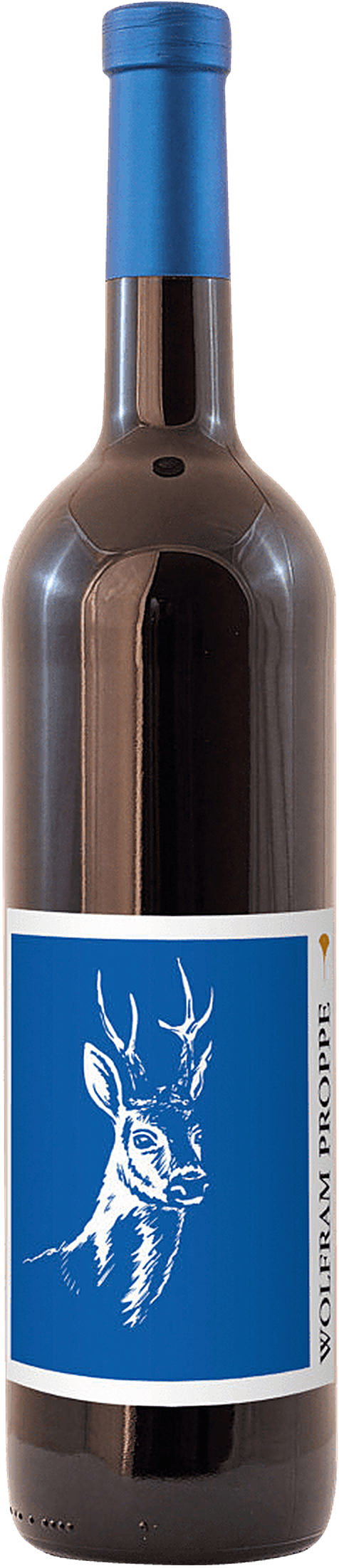
From Jena to the steep slopes of the Gleistal — Wolfram Proppe's path to his own winery
Wolfram Proppe was born in Jena in 1982, just a few kilometers from the vineyards that are his home today. After his apprenticeship as a winemaker, he studied viticulture, oenology, and distillery technology at the Weinsberg Teaching and Research Institute — the oldest German viticulture school. He spent his first years of practice in Württemberg, including as cellar master at the Thuringian winery Bad Sulza. In 2006, he returned to the region and revived an over 800-year-old viticulture tradition in the Gleistal near Golmsdorf: with the planting of the single vineyard Golmsdorfer Gleisburg, a chapter began that led to the founding of his own winery in 2007 — initially as a part-time job, and full-time since 2014. Wencke Proppe, a wine business economist (B.A.), runs the winery as Wolfram & Wencke Proppe GbR together with him: she is responsible for operational processes, external impact, and numerous quality components in the background.
Natural manual labor on shell limestone — what counts in the vineyard and cellar
The location of the vineyards is ideally suited: on the southern slope of the Großer Gleisberg, protected from westerly winds by the spur of the Jena Horseshoe, the single vineyard Golmsdorfer Gleisburg lies at the transition of the Gleistal to the middle Thuringian Saale valley. The soil of shell limestone and variegated sandstone is nutrient-poor and forces the vines to root deeply. This noticeably shapes the character of the wines. In the vineyard, manual labor takes precedence: the growth of the vines is specifically supported, but their character is determined by location, climate, and soil. Wolfram Proppe relies on late harvesting and sufficient ripening time to keep ripeness and tension in balance.
In the cellar, he combines traditional and contemporary methods with the clear goal of pressing gently and preserving grape variety typicality. The wines are created in deliberately small quantities — conviction, not a bottleneck. The golden ginkgo leaf in the winery's coat of arms refers to a regional heritage: Goethe, who knew and appreciated the Gleistal, is considered by the winery to be a silent reference to the wine and natural history of the region.
Auxerrois, Cabernet Jura, and the "New Masters" — an assortment with attitude
The focus is clearly on white wine. Wolfram Proppe is convinced that the climate around Jena has the potential for independent, precise white wines. The assortment includes Auxerrois — historically rooted in the Gleistal, fruit-soft with mild acidity — alongside Chardonnay, Pinot Blanc, Riesling, Bacchus, and Kerner. The wines show grape variety typicality, mineral character, and the imprint of the shell limestone soils. In addition, there are red wines: with Cabernet Jura, a fungus-resistant red grape variety with a profile similar to a Cabernet Sauvignon, Proppe is, by his own assessment, a pioneer in the Saale-Unstrut region. Cabernet Jura and Cabernet Blanc — an aromatic variety close to Sauvignon Blanc — are marketed together under the "New Master" line. The commitment to rare and historical grape varieties is not an end in itself: it is the common thread that holds together the origin, craftsmanship, and style of this winery.