From the Suga spring to the pioneer of the Cru-Brunello
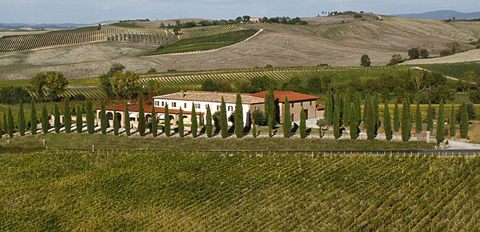
Val di Suga takes its name from the stream of the same name, which has been running through the northern slope of Montalcino since at least the 16th century. 1969 a company acquired the estate and began to gradually convert the land, which was then used as grazing land, into vineyards. The first harvest is recorded for 1973; the first wine marketed under the Val di Suga label dates back to 1975. In 1982, the estate put its own aging cellar into operation — and the very first officially marketed bottle, a Brunello Riserva from the 1977 vintage, came from the Vigna del Lago vineyard directly in front of the estate building. In 1994, the Tenimenti Angelini Group took over the winery and pushed ahead with modernization and international orientation; today, Val di Suga belongs to Bertani Domains.
Three exposures, three soils, one consistent logic
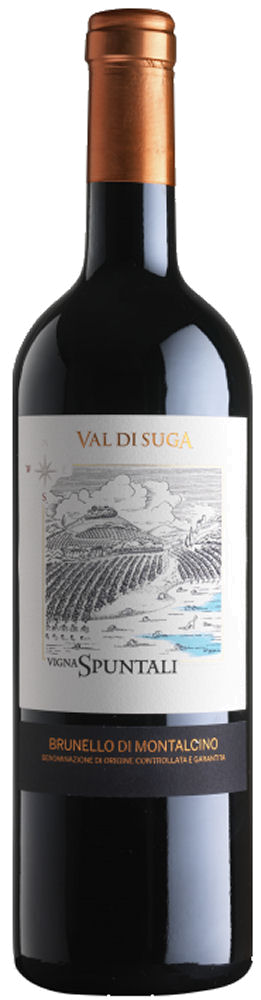
What distinguishes Val di Suga from other producers in Montalcino is not a question of style, but a geographical fact: the estate owns vineyards on the three main exposures of the hill — northeast, southeast, and southwest — with geologically independent soils. Vigna del Lago is located in the northeast on calcareous clay with interspersed, crumbly shale material at 270 to 320 meters. The climate there is mild and cool; the grapes are the last to be harvested. Vigna Spuntali in the southwest grows on sandy, Mediterranean soils about 300 meters above sea level; cooling winds from the Tyrrhenian Sea balance the heat of the exposure. Poggio al Granchio, acquired in 1999, is located in the southeast in the historic heart of the denomination. With this purchase, Val di Suga became the only producer in Montalcino to unite all three defining hillside locations in one hand — a total of 55 hectares, planted exclusively with Sangiovese Grosso.
In the cellar, the individuality of each vineyard is consistently continued. The Brunello di Montalcino (base wine) ferments at a controlled temperature in stainless steel tanks, matures for 24 months in large Slavonian oak barrels, and spends another twelve months in concrete containers before lying in the bottle for at least a year. Vigna Spuntali first spends six months in French barriques, then moves for 18 months into large Austrian oak barrels with a volume of 25 hectoliters — a two-stage approach that separates fruit depth and wood integration.
Characterful Brunellos for three faces of Montalcino
The base wine Brunello di Montalcino combines grapes from all three locations into a classic interpretation of the denomination: sour cherry, dried herbs, firm, well-integrated tannins, long spicy finish. Vigna Spuntali is considered the most structured and full-bodied of the three single-vineyard wines — candied orange, thyme, rosemary, and a mineral hint of iron-rich soil meet supple tannins with a creamy texture. Vigna del Lago is the most elegant line, characterized by cooler aromatics and a dense acid structure that gives the wine pull and length. The Rosso di Montalcino functions as a more accessible entry-level line into the estate's philosophy — the same Sangiovese Grosso, shorter maturation time, more directness. Anyone who tastes the three Cru-Brunellos side by side experiences a unique cross-section of the climatic and geological range of Montalcino.