From medieval church property to a niche winery in the heart of Chianti
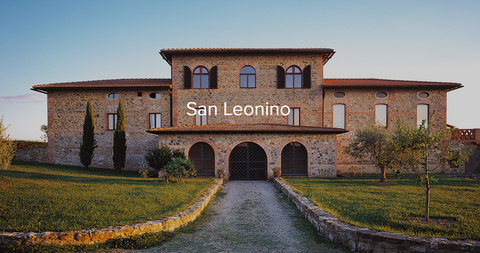
The name San Leonino goes back to the Romanesque parish church of San Leonino in Conio, which has given the estate its name and logo — the characteristic church tower — since its beginnings. The first documentary mentions of the church land date back to 1043, the oldest economic records to the decades between 1275 and 1300. At that time, the estate was located in the border area of the rival city-states of Florence, Siena and Volterra, which gave it a turbulent history: in 1384 it fell to the Florentine state and became part of the Lega del Chianti. The idea of the self-sufficient feudal farm dates back to this time — a community that provided for itself from its own resources and whose viticultural heritage is still palpable today. In recent decades, San Leonino has undergone several changes of ownership before the Angelini family took over the estate in 1994. Today, San Leonino is part of Angelini Wines & Estates, an association of six wineries in Italy, and remains a deliberately small niche winery with limited, artisan-led production.
Alberese soils, southern exposure and the principle of small quantities
The estate is located near Castellina in Chianti, in the historical core area of the DOCG, on a total area of around 100 hectares — 52 hectares of which are vineyards and 6 hectares are olive groves. The sites are oriented to the south and southeast and are located at three altitude levels between 270 and 430 meters. Loamy-sandy soils dominate at the bottom, while Galestro and the Alberese typical of Chianti Classico take over higher up — a lime- and skeleton-rich clay shale that forces the roots deep and gives the wines structure and minerality. The microclimate is influenced by nearby lakes and streams, which moderates the temperature differences between day and night and ensures aromatic depth.
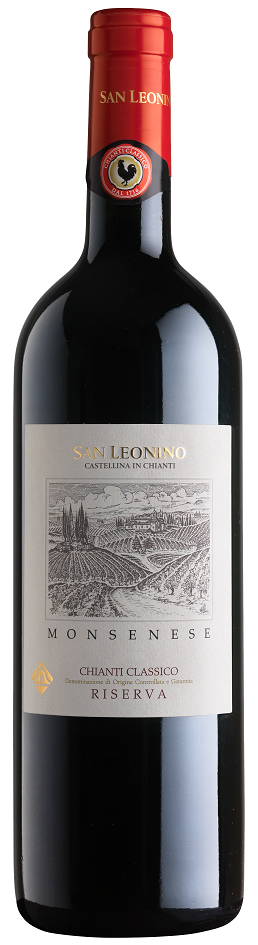
In the cellar, San Leonino pursues an approach focused on the grape variety: all wines are single-varietal Sangiovese cuvées. Artisan care and cellar research go hand in hand. After an 18-day temperature-controlled maceration period, the Al Limite matures for 18 months in 30-hectoliter Slavonian oak barrels as well as in cement vats. The Monsenese Riserva goes through the same maceration phase, but is then aged for 24 months in 300-liter barriques and subsequently matured in the bottle. Around 250,000 bottles leave the cellar annually, 60,000 of which are produced using the Governo method.
Sangiovese pure — and an old technique that was almost forgotten
The San Leonino range includes four wines, all made from pure Sangiovese: the Chianti Classico Al Limite, the Riserva Monsenese, the Gran Selezione Salivolpe and the Governo all'Uso Toscano. The Governo method is the oldest and most characteristic method of the house: a portion of dried Sangiovese grapes is added to the young wine, which triggers a second fermentation in 90-hectoliter barrels. The result is a wine with invigorating freshness, softer tannin and clear fruit — a technique that has largely been forgotten in Tuscany and is continued here with conviction. Across all wines, the house's leitmotif applies: origin and grape variety should speak, not the cellar. Anyone who tastes the Chianti Classicos Al Limite and Monsenese side by side gets a precise insight into how aging decisions can steer the same Sangiovese in different stylistic directions — from the taut minerality of the large wood to the dark fruit depth of the barrique.