Since 1815 on the south coast of Islay: The Johnston legacy
The history of Laphroaig begins in 1815, when brothers Donald and Alexander Johnston founded their distillery on the remote south coast of Islay, near Port Ellen. On a leased plot of land, they made use of what the island gave them: soft, peaty water from the Kilbride stream, dense peat bogs right on their doorstep, and a damp sea air that shaped the cask maturation from the very beginning. Alexander left Islay in 1836, Donald bought out his share and continued to run the distillery alone — until his death in 1847. The Johnston family kept Laphroaig together nonetheless: daughters, cousins, and finally Ian Hunter, who arrived in 1908 and modernized production, including the systematic use of ex-bourbon casks, which helps define the house style today. After Hunter's death in 1954, his manager Bessie Williamson took over — a rare constellation in Scottish whisky history. Today, Laphroaig belongs to Suntory Global Spirits, but every bottle still bears the addition “Distilled and bottled in Scotland by D. Johnston & Co.” — a deliberate reference to the founding brothers.
Craftsmanship without shortcuts: Peat, malt, and seven stills
What distinguishes Laphroaig from the vast majority of Scottish distilleries begins on the malting floor. Around 20% of their own barley is still turned by hand on-site and subsequently dried over a peat fire at a low temperature for ten to twelve hours — a cold-smoking process that drives phenolic compounds deep into the grain. The distillery cuts the peat for this from its own bog, the Glenmachrie Peat Moss: not forest peat, but a mixture of heather, lichen, moss, and ancient marine plant material from the time when Islay was still underwater. The result is around 40 ppm phenol content in the malt — significantly more than at most other Islay distilleries. The remaining barley is kilned off-site according to specification and then blended with the house malt. Distillation takes place in seven copper stills — three wash stills, four spirit stills — with characteristically rising lyne arms, which give the distillate a certain brightness without breaking the oily, maritime notes. The process water comes exclusively from the Kilbride stream, which flows directly through the distillery's own peat fields and gives the spirit its mineral undertone.
Smoke, iodine, and sea air: What to expect in your glass
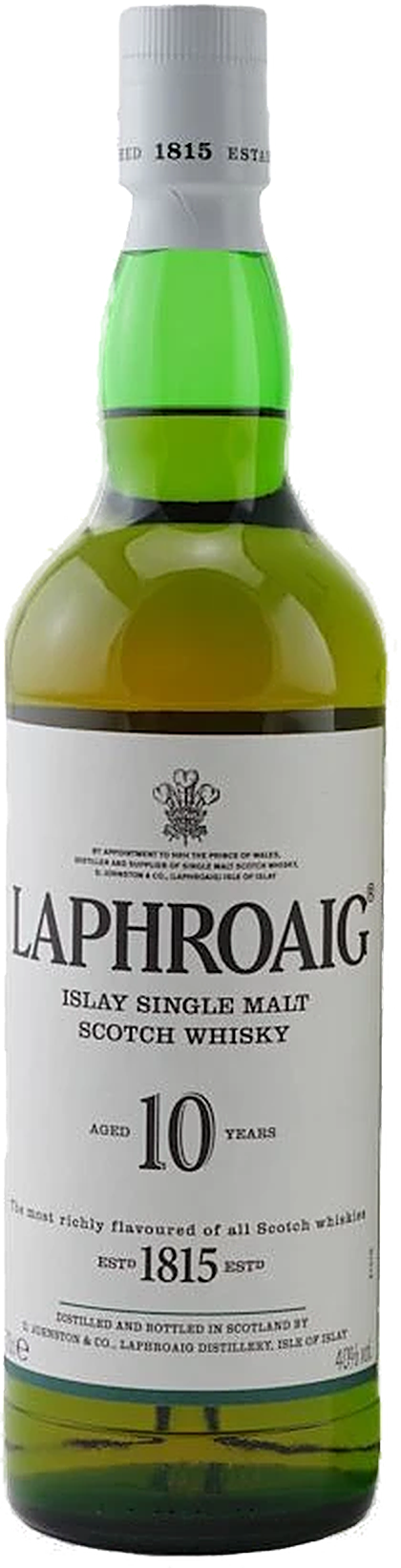
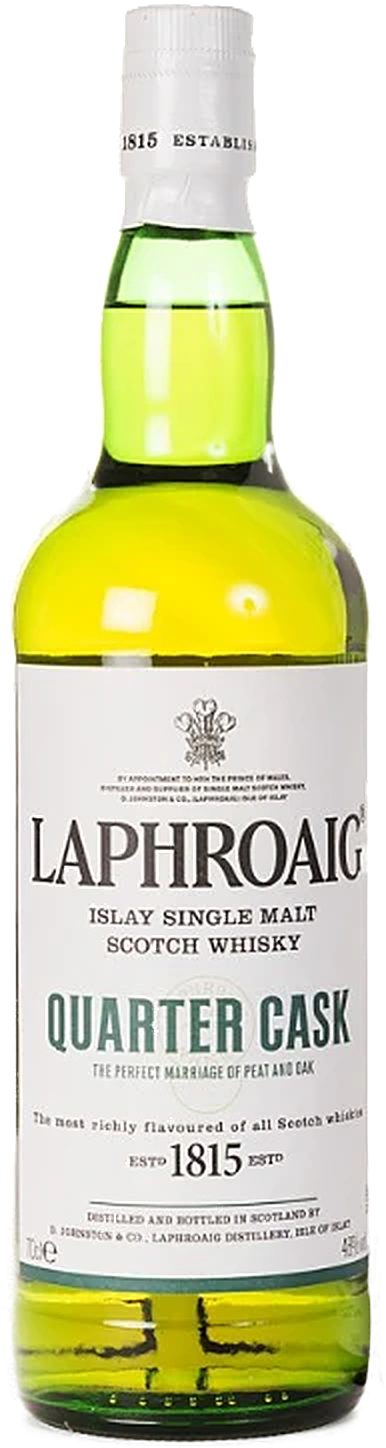
Laphroaig is not a whisky that seeks compromise. The Laphroaig 10 Year Old — the house reference — matures in first-fill ex-bourbon casks and displays tar, seaweed, iodine, and a long, slightly sweet smoky finish with salted caramel in the glass. After initial maturation, the Quarter Cask undergoes a period in smaller casks with greater wood contact: a shorter path to more vanilla and coconut tones, without the peat taking even a single step back. Both bottlings are exemplary of what the distillery has been doing for over two centuries: distilling a style that polarizes because it conceals nothing. Those who like Laphroaig like it uncompromisingly — neat, with a few drops of water, or on the rocks. The Royal Warrant that Prince Charles awarded the distillery in 1994 was the first and remains the only one ever granted to a Scottish single malt.