From the residence of the dukes to organic viticulture on the Layon
Château Soucherie dates back to a Métairie – a farmstead – of the Dukes of Brissac. At the end of the 19th century, a sister of the Duke, the Princess of Arenberg, had the estate expanded into a summer residence where she enjoyed her wines and received guests. In 1952, the estate passed into the hands of a winemaking family who made the name Château Soucherie known in the region. Since 2007, the Béguinot family has been running the winery: Roger-François Béguinot and his son Pascal have fundamentally restored the Château and cellar together with local craftsmen and reoriented the estate's viticulture.
The Château is located halfway up the slope above the Layon loop near Beaulieu-sur-Layon, about 20 kilometers south of Angers. From the terraces, the view sweeps over the hills of Anjou – a location that is not only picturesque but also counts climatically: southern exposure, protection from the north wind, slate underfoot.
Organic viticulture on slate, clay, and granite
The winery manages around 28 hectares on three spatially separated plots. The core is the hillside location directly around the Château: 22 hectares on a south-facing slate slope, enclosed by walls and protected from north winds. The soils of slate, clay, and sand shape the mineral framework of the wines. In addition, there are 4 hectares in the Chaume appellation – with vines over 70 years old, whose deep-reaching root systems demand all complexity from the soil – as well as the Clos des Perrières, 1.8 hectares of slate-granite soil in the heart of Savennières.
Since the 2022 vintage, the entire winery has been certified organic by Ecocert. The path there was consistent: no synthetic pesticides, no chemical fertilizers, all work in the vineyard by hand – from thinning to harvesting. In the cellar, decisions are made according to appellation and soil type: pneumatic pressing, slow natural fermentation, aging in stainless steel tanks or oak barrels, with wood origin, toast level, and cooperage being specifically selected. For the sweet wines, the grapes are harvested by hand in several selective passes (tries) and are not chaptalized.
Chenin Blanc in all its varieties – dry, sweet, complex
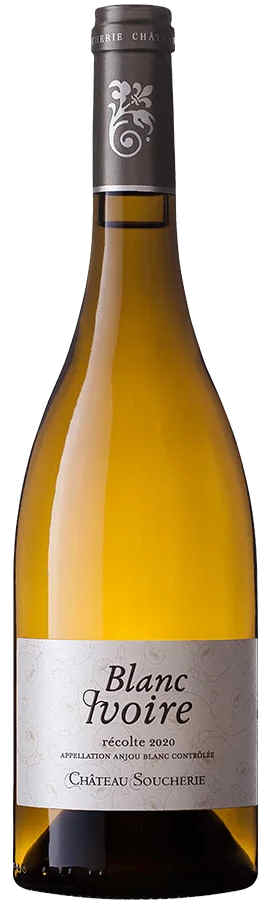
Château Soucherie is primarily a Chenin Blanc house. The grape variety is vinified as a single varietal across the entire white wine range – whether as a dry Anjou Blanc like the Blanc Ivoire, as a mineral Savennières from the Clos des Perrières, or as Coteaux du Layon and Premier Cru Chaume in the sweet style. Cabernet Franc provides the red wines and rosés; the local Grolleau ensures fruitiness and roundness in the rosés. The flavor profile of the white wines is characterized by the slate terroir: pronounced acid structure, a mineral backbone, aromas of quince, white peach, and citrus zest. The sweet wines from the Chaume plot – from vines that have been in the ground for over seven decades – show a concentration and depth that is typical for this enclave of Anjou. Anyone who wants to get to know Chenin Blanc in its most diverse forms will find an assortment at Château Soucherie that reflects exactly this range.