From the gravel ridge above the Gironde to the Médoc benchmark
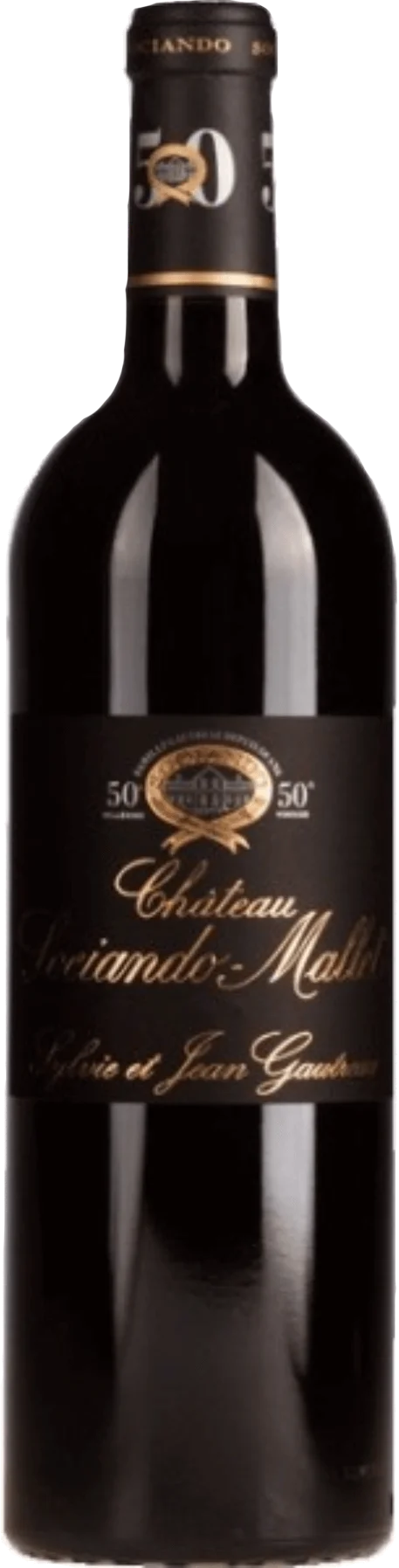
The history of Château Sociando-Mallet is documented as far back as March 1633, when a document from Saint-Seurin-de-Cadourne first mentions "nobles terres" belonging to a Basque nobleman named Sossiondo. Over the centuries, the estate changed hands — confiscated after the French Revolution, it came into the possession of a naval captain named Mallet in the 19th century, who gave the Château his name according to the custom of the time. This is how the double name, which remains to this day, was created.
The decisive turning point came in 1969. Jean Gautreau, a Négociant from Lesparre and a pioneer of mobile bottling in Bordeaux châteaux, was looking for a winery with good terroir for a Belgian client. When he saw Sociando-Mallet — at that time just five hectares, dilapidated buildings, no proper cellar — he bought it himself without further ado. The price: 250,000 francs. What attracted him was the location: a striking gravel ridge, the Butte de Baleyron, with a direct view of the Gironde. From an original size of less than eight hectares, Gautreau expanded the winery to around 83 hectares under vine — and in doing so, created one of the most uncompromising Haut-Médoc wines of all. Since Jean Gautreau's death in 2019, his daughter Sylvie has continued to run the estate.
Hand-picking, spontaneous fermentation, new oak — consistency without shortcuts
Sociando-Mallet is neither a Grand Cru Classé nor a Cru Bourgeois — a conscious decision by Jean Gautreau, who did not apply for any classification. The winery thus stands outside any official ranking system, which gives it a rare freedom to this day. The foundation is the terroir: Gunzian gravel over a clay-limestone subsoil, the location high enough to fully utilize the moderating influence of the river. The vines are on average around 30 years old, are harvested exclusively by hand in small crates — around 120 harvest workers are employed for this purpose — and are manually sorted on a conveyor belt.
In vinification, Sociando-Mallet relies on natural yeasts from the vineyard and the cellar, temperature-controlled steel and concrete tanks, and daily pumping over for color and aroma extraction. Malolactic fermentation takes place in the tank. Subsequently, the batches selected for the grand wine mature for twelve months in 100% new French oak barrels. The total aging period is around 18 months before bottling at the Château.
Dark fruit, graphite, firm structure — and a long finish
The Haut-Médoc from Sociando-Mallet is a cuvée that, depending on the vintage, is close to a balance of Merlot and Cabernet Sauvignon, supplemented by a small proportion of Cabernet Franc. On the nose, there are black berries, cassis, pressed violets, and a distinct graphite tone; on the palate, firm, densely woven tannins, a taut acid structure, and a lingering finish follow. The style is straightforward Médocain — substantial without heaviness, precise without coolness. The second wine, La Demoiselle de Sociando-Mallet, draws from the same vineyard and offers the characteristic estate style in a more accessible form. Since 1995, a small special bottling has also been released under the Jean Gautreau label, from only about one percent of the harvest, with longer barrel aging and a higher proportion of Cabernet Sauvignon. Recommendation for the grand wine: 16–18 °C, with leg of lamb with herbs, aged Comté, or game poultry.