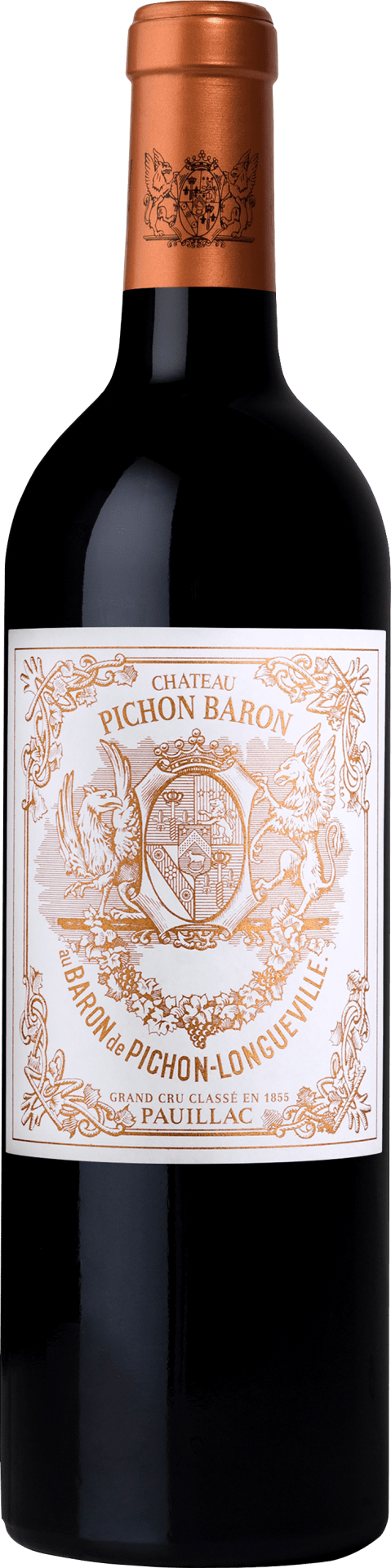
From President of Parliament to Bordeaux icon: the history of Pichon Baron
The roots of the estate go back to the late 17th century. 1694 Thérèse de Rauzan, daughter of the influential wine merchant Pierre de Rauzan, married the President of the Bordeaux Parliament, Jacques de Pichon Longueville — the estate passed into the family as a dowry and has since carried the name that is inseparable from the Médoc landscape. After the death of the last baron, the inheritance was divided among his five children in 1850: the male part became Château Pichon Baron, the female part became the now neighboring Château Pichon Comtesse de Lalande. In 1851, Baron Raoul had the striking Renaissance-style château built, which still defines the face of the estate today.
In 1933, the Pichon de Longueville family sold the property to the Bouteiller family, who managed it for over five decades. 1987 AXA Millésimes took over the Château with the declared goal of exploiting the full potential of the terroir. A comprehensive renewal followed: the cellar building and fermentation cellar were completely redesigned from 1988, and in 2008 an underground barrel cellar was added, which extends under the reflecting pool in front of the Château. Since 2022, Pierre Montégut has been responsible for the vineyard and cellar as Technical Director.
Plot-based work on Pauillac gravel: terroir and craftsmanship in focus
The vineyard covers around 73 hectares at the southern end of Pauillac, immediately adjacent to Château Latour. The best sites are located on the Pauillac plateau, where deep Quaternary gravel soils over a limestone-clay subsoil ensure excellent drainage. The proximity to the Gironde noticeably moderates the climate. The vineyard is planted with 65% Cabernet Sauvignon, 30% Merlot, 3% Cabernet Franc and 2% Petit Verdot — around 9,000 vines per hectare, trained using the double Guyot method. Since 2003, the estate has been certified according to the French standard for sustainable viticulture; cover crops for soil aeration and targeted water resource management are now part of the fixed work program.
In the cellar, the principle of plot-by-plot vinification applies: each of the approximately 70 individual pieces is aged separately to preserve its individual character. The maceration time is three to four weeks, after which the Grand Vin matures for 18 to 20 months in barriques. Only grapes from the 30-hectare plateau block are used for the Grand Vin; the remaining plots provide the second wines Les Griffons de Pichon Baron and Les Tourelles de Longueville.
Classic Pauillac profile: structured, Cabernet-driven, cellar-worthy
Stylistically, Pichon Baron stands for what connoisseurs associate with Pauillac: dense tannins, firm acidity structure, a core of black fruits — cassis, dark plum — as well as hints of cedar wood and graphite, which result from the high Cabernet Sauvignon content and barrel aging. Not a wine for immediate drinking pleasure, but for patient cellars and demanding tables. As a food accompaniment, powerful meat dishes are suitable: rack of lamb with a herb crust, duck breast, braised beef cheeks or mature hard cheese.
In the Vinoscout range, you will find the Grand Vin as a Second Growth classified in 1855 — one of the few Bordeaux wines that has permanently proven this rank since its initial classification.