From Benedictine monks to the Roulleau family: over 800 years of Dauzac
The roots of Château Dauzac in Labarde reach back to the Middle Ages. The earliest known owner in this part of Margaux is considered to be Pétrus d'Auzac, documented for the year 1190. In 1545, the Benedictine monks of the Sainte-Croix Abbey in Bordeaux described the property as a "Bourdieu," a country house with a vineyard. From 1685, the Bordeaux wine merchant Pierre Drouillard developed the estate into one of the significant wineries of the Médoc.
In the 1855 classification, Dauzac was ranked as a Fifth Cru Classé, at that time under the Wiebroock family. In 1863, the Johnston merchant family took over. During this time, the manager Ernest David turned the estate into an experimental field. Dauzac is considered the place where Bordeaux mixture was created to combat downy mildew. After the Miailhe and Chatellier families, the insurer MAIF acquired the Château in 1989 and built a new gravity-flow cellar in 2004. Since 2020, Dauzac has belonged to the Roulleau family and is thus once again a family-owned property.
One block, 10,000 vines per hectare, and biodynamic manual labor
The estate comprises 120 hectares, of which 49 hectares are vines in a single block: 45 hectares in the Margaux appellation, 4 hectares in Haut-Médoc. This is rare in Margaux. Meadows and forest protect the vines from the winds from the sea, and the nearby Gironde estuary moderates temperature fluctuations. The soils consist of deep gravel ridges. Soil surveys and electrical resistance measurements showed which plot can tolerate which grape variety and rootstock. The planting density is 10,000 vines per hectare, with 69% Cabernet Sauvignon, 29% Merlot, and 2% Petit Verdot.
For several years, Dauzac has been managing its vineyards increasingly biodynamically, using plant-based preparations from the region. Harvesting is done by hand, partly according to the biodynamic calendar on fruit days. The grapes pass over a sorting table before and after destemming. In the gravity-flow cellar, they ferment with natural yeasts from the vineyard, in wooden vats with double, transparent staves, without pumping over. On one plot, there are own-rooted Cabernet Sauvignon vines without rootstock, selected from the best vines of the estate.
Cabernet structure from Labarde: from Grand Vin to Franc de Pied
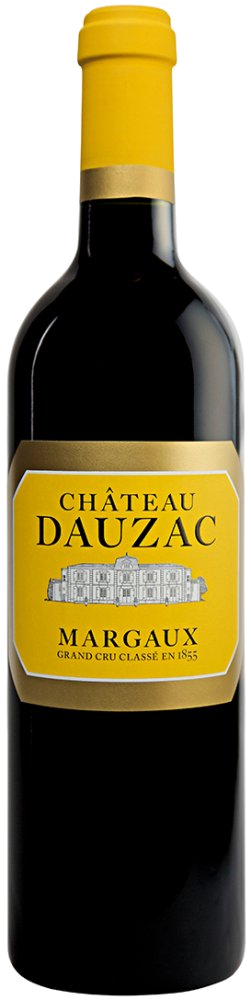
The Grand Vin is a Cabernet Sauvignon-dominated blend with Merlot, in the 2020 vintage, for example, 72% to 28%. It matures for 15 months in French barriques, 66% new in 2020. Tasting notes for the 2016 vintage mention dried herbs, blueberries, and cherries, plus firm acidity and fine tannins. This pairs well with rack of lamb, entrecôte, or aged hard cheese. Serve it at about 16 to 18 °C.
In addition to the Grand Vin, the estate bottles other wines. The Comte de Dauzac appears as Margaux, Haut-Médoc, and Bordeaux. Aurore de Dauzac comes from fine, sandy gravel soils and focuses on freshness. Since the 2021 vintage, there has been the Franc de Pied, a single-varietal Cabernet Sauvignon from own-rooted vines. This allows you to get to know different sides of Margaux within one address.