From cloth merchant's estate to Troisième Grand Cru Classé: Seven centuries of Giscours
The first documentary mention of Giscours dates back to the year 1330 — at that time as a fortified facility in the municipality of Labarde. The actual foundation for viticulture was laid in 1552 by Pierre de Lhomme, a wealthy cloth merchant from Bordeaux, who acquired the "Guyscoutz" estate and planted the first vines on land that had been wild until then. Two centuries and several changes of ownership later — including a brief episode as national property after the French Revolution — the industrialist Marc Promis gave the estate its current face: he had the elegant neoclassical château built, which still stands in Labarde today. His successor Jean-Pierre Pescatore continued to invest in prestige and infrastructure, thereby enabling Giscours to be classified as a Troisième Grand Cru Classé in the famous Bordeaux classification of 1855.
In 1995, a new chapter began: the Dutch entrepreneur Eric Albada Jelgersma took over the Château and initiated a comprehensive realignment of the vineyard and cellar. Today, his three children Dennis, Derk, and Valérie manage the estate — and with them Technical Director Didier Forêt, who has significantly shaped the qualitative renewal of the past decades.
Agroecology instead of chemical clubs: How Giscours thinks about its vineyard
Château Giscours manages around 160 hectares of vines — 100 hectares within the Margaux appellation, 60 hectares in the Haut-Médoc — divided into about thirty individual plots on the gravel plateaus of Labarde and Arsac. The oldest vines date back to 1923 and root deeply in a soil of Garonne gravel over a Stampian limestone layer — classic Margaux terroir with excellent drainage. It is planted with the four Bordeaux grape varieties Cabernet Sauvignon, Merlot, Cabernet Franc, and Petit Verdot.
In the vineyard, the team follows the principle of agroecology: agriculture and the natural environment are understood as a connected ecosystem. Old plots are preserved through interplanting — the targeted replanting of young vines between existing old vines — instead of being cleared. To ensure genetic diversity, Giscours uses mass selections from the estate's historical vine material for new plantings, which is at least 70 years old and predates clonal selection. In the cellar, the process begins with cold maceration before alcoholic fermentation, which improves fruit clarity and expressiveness. Fermentation and maturation follow the previous cellar tradition: plot-specific vinification, controlled temperatures, extended maceration time, malolactic fermentation. Finally, the wines mature for 15 to 18 months in French oak barriques (50% new wood, medium toast) from a pool of ten different coopers.
Structure, elegance, and the sign of the mermaid: the wines of Giscours
Since the realignment starting in 1995, Cabernet Sauvignon has been clearly at the center of the Grand Vin — a change that corresponds far better to the terroir on the gravel ridges of Labarde than the previously dominant Merlot assemblage. The result is wines with dense structure, fine tannin definition, and the aromatic precision typical of Margaux: dark berry fruit, floral undertone, long mineral finish. The guideline in the cellar is "aromatic radiance and fine tannins" — not a heavyweight, but a wine that combines depth with elegance.
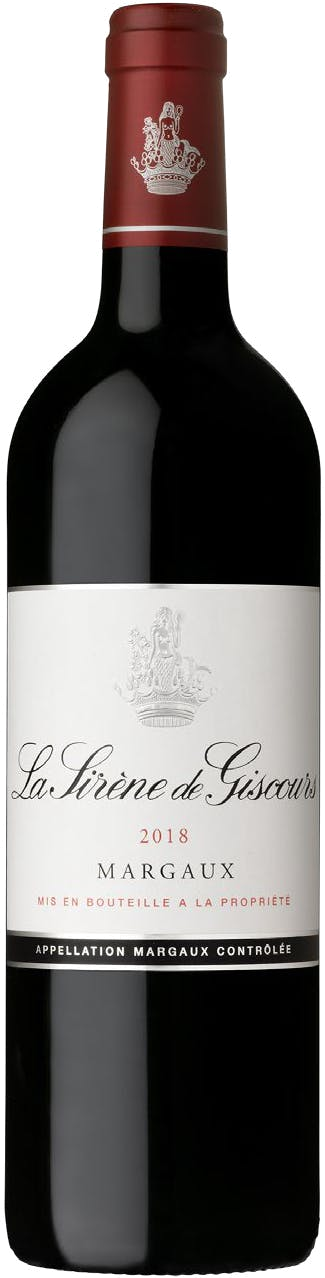
The range includes the Château Giscours Margaux as the Grand Vin as well as La Sirène de Giscours as the second wine — named after the mermaid that has adorned the house's label since 1900 and gives the second wine its name. La Sirène de Giscours also comes from Margaux plots and follows the same principles of plot-by-plot vinification, while being more accessible and enjoyable earlier. Both wines stand for an estate that has converted its eventful history into quality — and that fills its place among the classified growths of 1855 with conviction today.