From Jean-Baptiste Braneyre to the Maroteaux family: 340 years in Saint-Julien
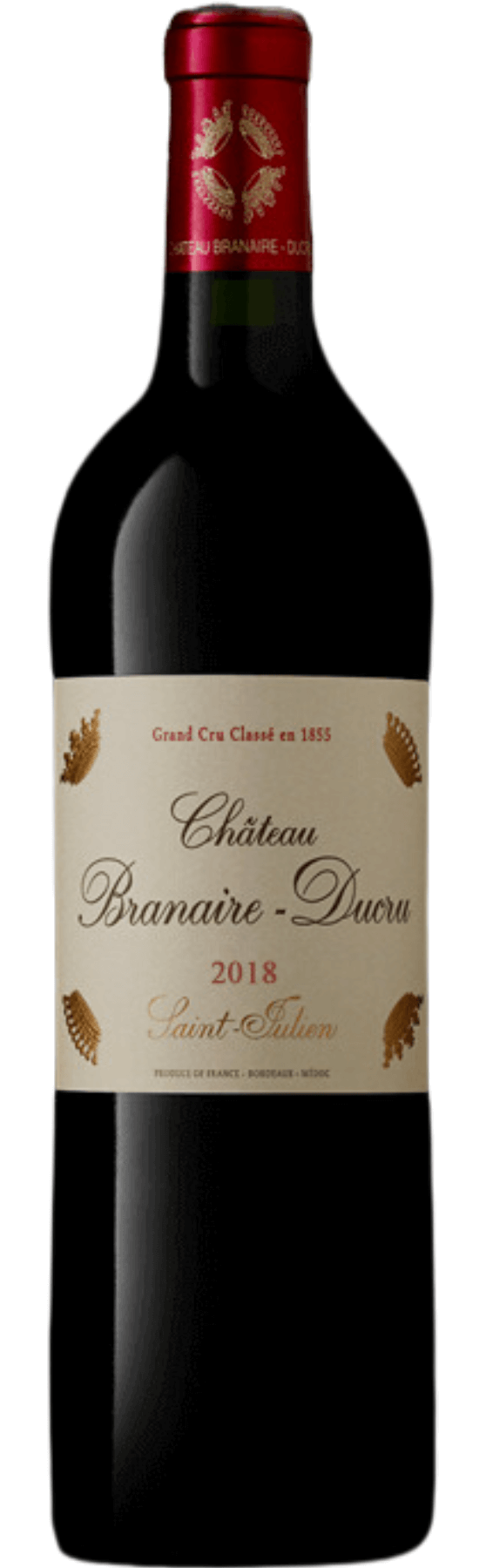
The roots of Château Branaire-Ducru reach back to the year 1680, when the Bordeaux notary Jean-Baptiste Braneyre acquired plots that had previously belonged to the extensive Beychevelle estate. The estate remained in family hands for generations, went through several inheritances and name changes — only with the transition to the Du Luc family did it receive its current character. In 1824, the Du Lucs had the Château built in the neoclassical style, which still stands on the estate today. A relative, Gustave Ducru, finally gave the winery its second name part; in the Bordeaux classification of 1855, Branaire-Ducru was classified as Quatrième Grand Cru Classé — a rank it has held unchanged to this day.
The decisive restart came in 1988, when Patrick Maroteaux acquired the Château and renovated it extensively: vineyards, cellars, and the Château itself were fundamentally renewed. Maroteaux was involved far beyond his own winery — he chaired the Union des Grands Crus de Bordeaux from 2000 to 2008 and led the Saint-Julien appellation from 2004 to 2017. After his death in 2017, his son François-Xavier Maroteaux, who had previously completed a career in the financial sector and at LVMH, took over the full management of the family business.
Gravity instead of pumps: craftsmanship with a clear attitude
As early as 1991, Patrick Maroteaux introduced gravity-based filling of the tanks — at a time when this was still an exception in the Médoc. This principle of treating fruit and structure as gently as possible runs like a red thread through the entire vinification. In 2024, the idea was consistently brought to completion: Branaire-Ducru opened the first fully gravity-fed fermentation cellar in the Médoc with 65 suspended stainless steel vats of different sizes, so that each plot can be vinified separately.
In the vineyard, the estate relies on traditional plowing between the rows and leaf trimming adapted to soil composition and vine density. Young vines are drawn from the estate's own selection of old vines. The manual harvest of each plot is controlled by phenol analyses and berry tastings. In the cellar, the Grand Vin lies for 16 to 20 months in French barriques from different forest areas, with light toast and a proportion of 60 to 65% new oak — enough structure without covering the fruit. Jean-Dominique Videau works as cellar master, and he is advised by consultant Eric Boissenot.
Cabernet depth, silky texture: the style of Branaire-Ducru
The heart of the winery is around 60 hectares of vineyard area on the Beychevelle plateau, spread over around 70 plots with a good dozen different soil types — deep gravel dominates, providing drainage and concentrated aromatics. The assemblage of the Grand Vin consists of about 65% Cabernet Sauvignon, supplemented by Merlot, Petit Verdot, and Cabernet Franc. The result is a wine that the team describes with three key terms: fruit, freshness, finesse. Dark berry fruit, subtle spice, and a silky-precise tannin structure make the style recognizable — without the heaviness that characterizes some Médoc wines.
In addition to the Château wine, Branaire-Ducru produces a second wine with Duluc de Branaire-Ducru, which mainly comes from young vines and is accessible earlier. 75% of production goes to export — Branaire-Ducru is thus a classic example of the international reputation of the Saint-Julien appellation.