From Marius to Michel: Two centuries on the Rhône
The history of Maison M. Chapoutier begins in 1808 at the foot of the Hermitage hill in Tain-l'Hermitage, in the heart of the northern Rhône Valley. What began as a small trading house eventually became a family: Marius Chapoutier, ancestor of the current head of the house, was the first winemaker in the region to press his own grapes — a decision that made Chapoutier an producer rather than just a merchant from the start. In 1929, Marius had a new winery built at the foot of the Hermitage hill; his son Marc took over and continued to shape the house as "M. Chapoutier". The decisive turning point came in 1990, when Michel Chapoutier — the seventh generation of the family — took over management and fundamentally realigned the winery.
Michel took on the legacy of a respected but stalled house and immediately focused on radical change: lower yields, consistent single-vineyard vinification, and a biodynamic approach that was anything but a matter of course in the Rhône Valley at the time. The family motto "Fac et spera" — do and hope — aptly describes this attitude.
Biodynamics as a conviction, not a marketing strategy
Since 1991, biodynamics has formed the foundation of every decision in the vineyard. Chapoutier is thus one of the early pioneers of this cultivation philosophy in France and is now Demeter-certified. In the Rhône Valley, chemical pesticides and herbicides are prohibited on all vineyard areas; the soils are worked manually, and ecosystems are actively protected. The basic idea that Michel Chapoutier adopted from Rudolf Steiner's approach: A vine never lives alone — it is part of a soil life that determines plant strength, aroma diversity, and ultimately the character of the wine.
In the cellar, the house relies on spontaneous fermentation with natural yeasts, aging in adapted oak barrels, and the complete avoidance of fining and filtration. The goal is minimal intervention — the wine should let the terroir speak, not the cellar technology. Chapoutier is also known for a detail unique worldwide: since 1996, every bottle has carried the wine name in Braille — a sign of respect for visually impaired people that no other large winery has consistently adopted to this day.
Hermitage power and Rhône breadth: the range at a glance
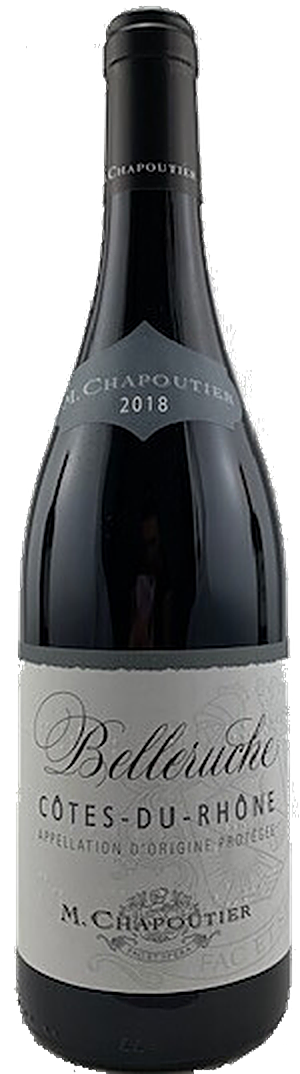
Chapoutier is both a domaine and a négociant — and with over 30 hectares, the largest private owner on the legendary Hermitage hill. On granite and slate, single-vineyard cuvées such as Le Pavillon (Syrah) or L'Ermite (Marsanne) are created here, which are among the most sought-after wines in France. Châteauneuf-du-Pape, Côte-Rôtie, Crozes-Hermitage, and Saint-Joseph complement the northern Rhône portfolio. In the south, the Côtes du Rhône provides the most accessible entry into the house with the Belleruche — whose name means "beautiful beehive" in French and alludes to the blooming biodynamic vineyards: a Grenache-Syrah-Mourvèdre blend with depth beyond its category. Those who understand Chapoutier understand the Rhône.