From the mobile distillery to a world-class distillery
The history of Nonino Distillatori begins in 1897, when Orazio Nonino founded the family's first permanent distillery in Ronchi di Percoto, a district of Pavia di Udine in the northeastern Italian region of Friuli. Previously, the family had driven their mobile distillery from farm to farm to distill the pomace of Friulian winemakers directly on-site. The step to a permanent location was more than logistical: it laid the foundation for an artisanal philosophy that would revolutionize the world of grappa four generations later.
The decisive turning point was December 1, 1973. On this day, Benito Nonino and his wife Giannola distilled the pomace of the Picolit grape as a single varietal for the first time, creating the Monovitigno® Nonino — the world's first grappa made from a single grape variety. To convince the winemakers, the family paid a premium to keep the Picolit pomace separate from the other grapes. The result — an aromatically precise, elegant grappa — permanently changed how Italy's most famous spirit is produced and perceived. 1984 saw the next innovation: the Acquavite d'Uva ÙE®, a pomace brandy made from the whole grape, which could only be produced after a special ministerial decree. Today, the three daughters Cristina, Antonella, and Elisabetta, as well as granddaughter Francesca Bardelli Nonino, continue to run the company — now in the sixth generation.
Craft without shortcuts: Fresh pomace, copper stills, sealed cellar
The heart of production is the immediate handling of the raw material. Nonino processes exclusively fresh, destemmed pomace, which is brought to the distillery on the day of winemaking. The family consistently rejects industrial continuous-flow systems: all distillates are created in discontinuous copper stills — five traditional distilleries with a total of 66 artisanal batch systems are located on the site in Percoto. Because each batch is managed individually, the family can precisely separate the heads and tails and preserve the aromatic heart.
The maturation of the Riserva and Barrique bottlings takes place under state seal — an official from the customs and monopoly authority opens the cellars when barrels are removed. In the cellars, 2,400 barriques and small barrels made of Limousin, Nevers, and Grésigne oak as well as sherry casks are stored without the addition of coloring. The Noninos' commitment goes beyond the distillery: in 1975, Benito and Giannola founded the Risit d'Aur prize to preserve endangered indigenous grape varieties of Friuli — including Schioppettino, Pignolo, and Tazzelenghe — and to politically enforce their replanting.
Single-varietal grappa, aged Riservas, hand-blown bottles
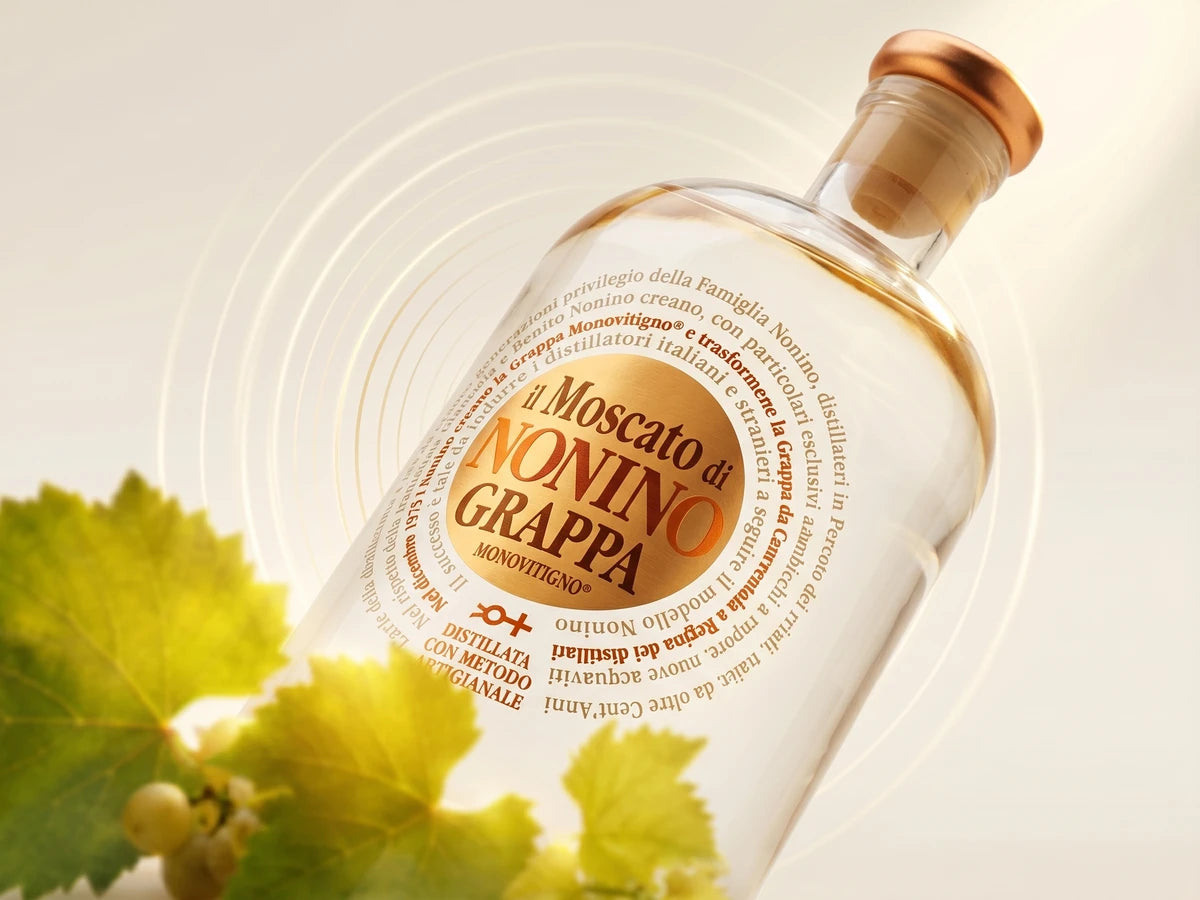
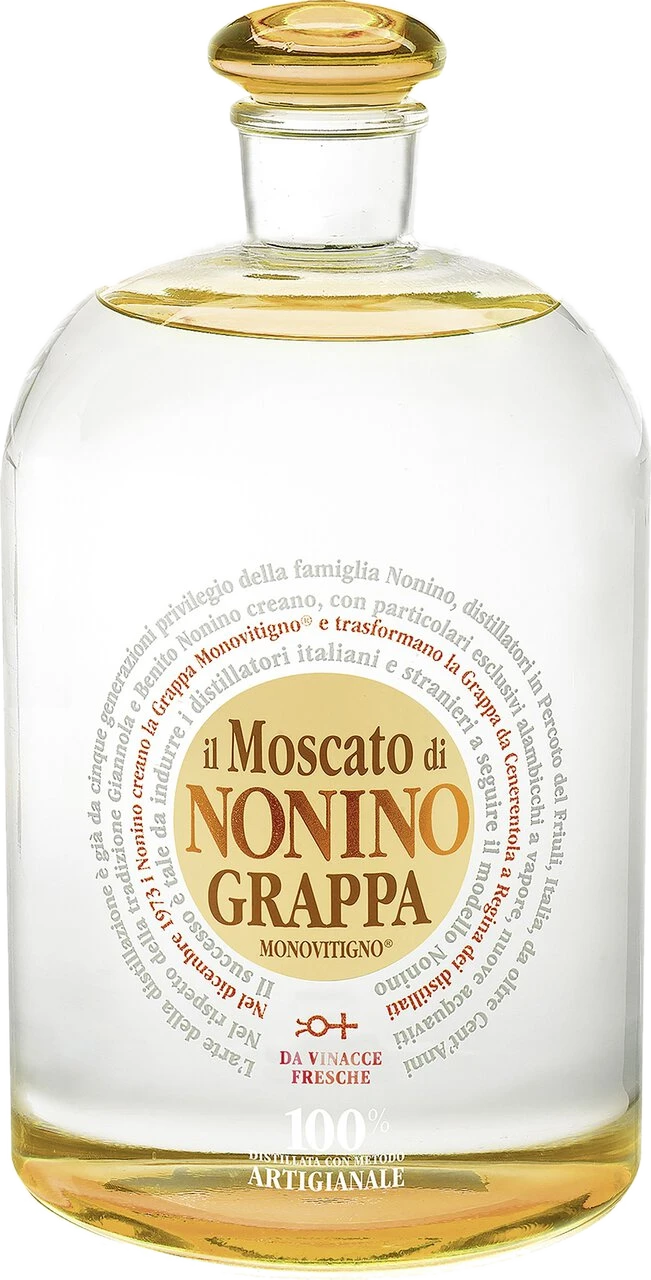
The Nonino range revolves around the idea that a grappa should reflect the personality of its original grape variety. The Monovitigno® line includes, among others, Moscato, Chardonnay, and Picolit — each bottling made from single-varietal pomace that transfers the typical terpene aromas of the respective grape variety into the brandy. Those looking for more depth and complexity will find it in the barrique-aged bottlings and the Antica Cuvée Riserva, a blend of grappas from different vintages that are aged for between five and twenty years in various wooden barrels. Depending on the bottling, the aroma profile ranges from floral-fruity freshness to notes of vanilla, dried fruits, and dark chocolate in the long finish.
For special bottlings — above all the ÙE® Cru Monovitigno® Picolit — Nonino has been working with Venini from Murano for decades: the bottles are hand-blown, numbered, and labeled with the respective vintage. The Gran Riserva 27 Years was the first Italian distillate to be awarded 100 points at the Falstaff Spirit Trophy. Serving temperature: 10–14 °C, preferably a little warmer for aged Riservas so that the wood notes can unfold.