Community as a founding idea: 1927 in the heart of the Mâconnais
When the aftereffects of the phylloxera crisis and the economic upheavals of the interwar period put the winemakers of southern Burgundy under pressure, the vignerons around the village of Azé joined forces. In 1927, they founded the Cave Coopérative d'Azé — not out of idealism, but out of tangible necessity: purchasing machinery together, pressing together, surviving together. The idea worked. What began as a pragmatic emergency community is today one of the deeply rooted cooperative wineries in the Mâconnais, embedded in the geographical triangle between Mâcon, Tournus, and Cluny.
Today, around 60 partner farms jointly cultivate around 280 hectares of vineyards. The Cave is part of the Alliance des Vignerons Bourgogne-Beaujolais and the Compagnie de Burgondie, an association of several Mâconnais cooperatives that bundles logistics, marketing, and distribution — without the individual cellars giving up their independence.
From pruning to certification: craftsmanship with a systematic approach
The vineyards of the Cave d'Azé stretch across hills that lie between 240 and 440 meters in altitude. Limestone soils dominate, and occasionally silex can also be found — flint, which leaves a crisp minerality on the nose of the wines. Pruning is carried out exclusively by hand, step by step through the winter into spring, regulated according to the specifications of the respective appellation. In the spring, the ébourgeonnage follows: excess shoots are removed to concentrate the plant's energy on the remaining grapes.
Two experienced oenologists oversee the vinification and watch over the style and consistency of the entire cuvée range. Since 2012, the Cave has been ISO 22000 certified — a food safety standard that ensures complete traceability from the vineyard to the bottle. In addition, there is certification according to the French Haute Valeur Environnementale standard (HVE), which sets requirements for biodiversity, plant protection, and resource efficiency. In concrete terms, this means: greened vineyard row interspaces, newly planted hedges and trees around the plots, a reduced bottle weight to lower transport CO₂, as well as FSC-certified natural corks. A cuvée without added sulfur shows that the cooperative is also ready to break new ground in the cellar.
Mâcon Azé, Crémant, Bourgogne Rouge: an assortment with a clear Mâconnais signature
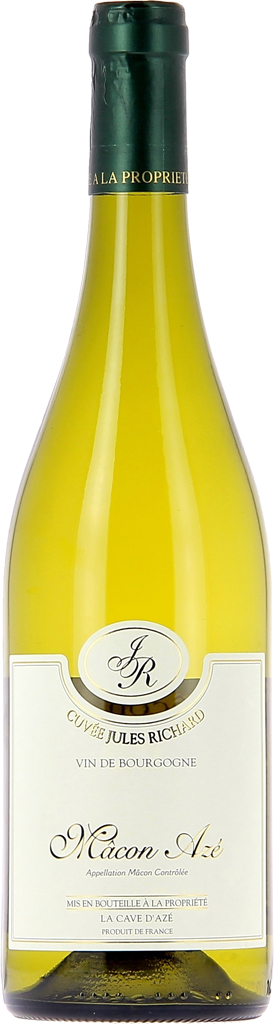
The centerpiece of the assortment is the Mâcon Azé — as a Blanc, Chardonnay dominates, which develops a fresh, citrus-toned fruit on the limestone soils of the appellation: white peach, pear, a hint of stone minerality in the finish. The Jules Richard cuvée represents the classic entry into Mâconnais white, while sites like Les Milles Pierres or the Mâcon Péronne, characterized by silex soils, bring more texture and depth. The range is complemented by Bourgogne Blanc and Bourgogne Rouge from the oak barrel, Bourgogne Aligoté with a crisp acidity line, as well as a Crémant de Bourgogne in white and rosé. Those who want to get to know the assortment should start with the Mâcon Azé Blanc — serving temperature 10–12 °C, accompanied by grilled fish, chèvre, or a classic poultry dish from the region.