From Mainz accountant to Champagne house in Reims
Joseph Krug was born as Johann-Joseph Krug in Mainz in 1800. Via Paris, he reached the Champagne house Jacquesson and learned there how to compose wines and assess customer tastes. In 1843, he founded his own house in Reims. His ambition was to make the best possible Champagne every year, even if the climate did not cooperate. In 1848, he recorded this attitude in a personal notebook. It is still considered the foundation of the house philosophy today.
After Joseph's death in 1866, his son Paul continued to run the house. Today, the sixth generation of the Krug family leads the company, with Olivier Krug as house director. In the early 1970s, brothers Rémi and Henri Krug acquired a walled Chardonnay vineyard in Le Mesnil-sur-Oger. The first Clos du Mesnil was created from it in 1979. Since 1999, Krug has belonged to the LVMH group.
Every plot on its own, every barrel individually
Krug works with the idea that every site and every plot has its own character. According to The Buyer, the house works with around 100 winegrowers and uses all three Champagne grape varieties from the entire region. The wines are vinified separately by plot, in small oak barrels of 205 liters. This is unusual for large Champagne houses, because most have long since switched to stainless steel. Krug sticks to this and thus gains texture and depth.
The second foundation is the library of reserve wines. It includes wines from many vintages and compensates for harvest fluctuations. Joseph Krug also did not want any hierarchy among his cuvées: they were to be equal and only show different forms of expression.
Grande Cuvée, Clos du Mesnil, and the other cuvées
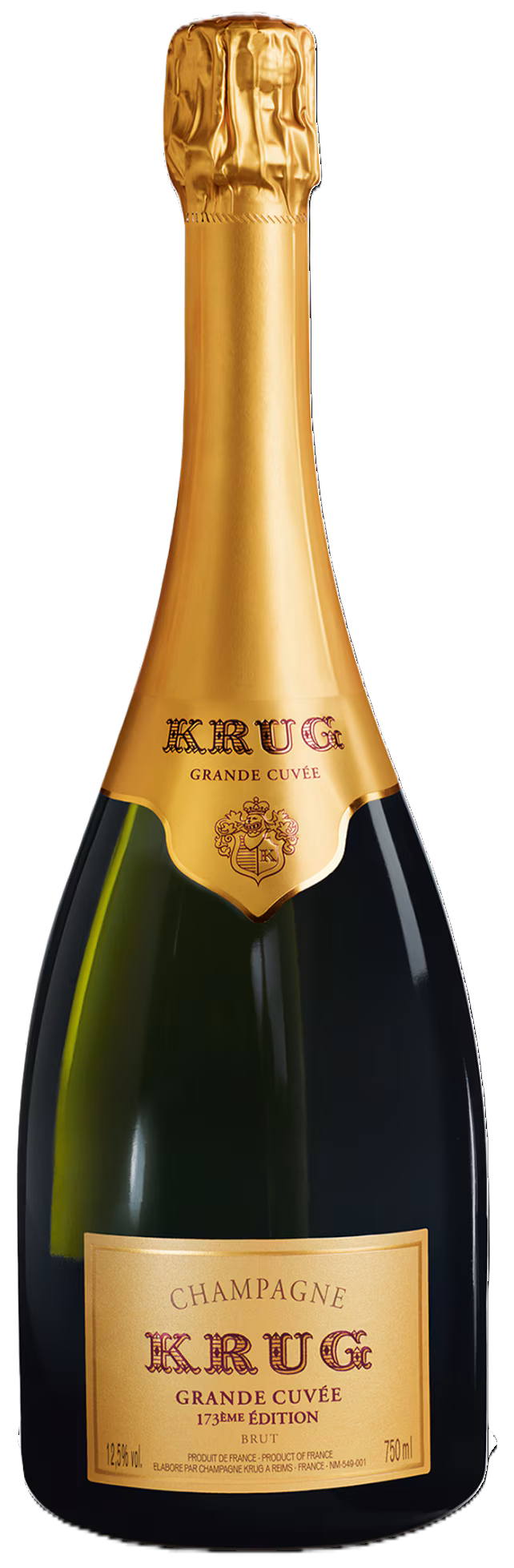
The Grande Cuvée is the heart of the house. It is recomposed every year from more than 120 wines from at least ten vintages. It then matures for about seven years before it leaves the house. Each bottling bears a number, the Édition, and refers to its base vintage. On the label, you can therefore see which composition is in the glass. In the glass, you can expect aromas of bread dough, toasted hazelnuts, and ripe fruit, plus a fine perlage.
Jabugo ham, aged Comté, and oysters pair well with this style. Grilled shrimp, curries from Indian or Moroccan cuisine, and Tarte Tatin also harmonize with it. In addition to the Grande Cuvée, a rosé, a vintage Champagne, and two single-vineyard Champagnes belong to the range: the Clos du Mesnil made from pure Chardonnay and the Clos d'Ambonnay made from pure Pinot Noir.