From fallow vineyard to the flagship of the Côtes de Francs
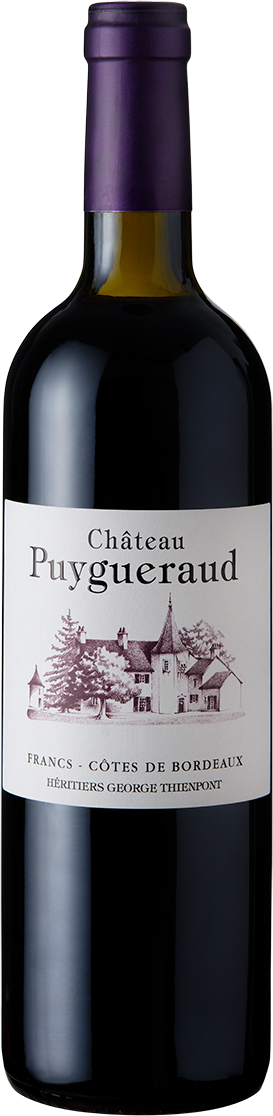
Château Puygueraud is located near Saint-Cibard on a rocky plateau. From there, you look over the Dordogne valley towards Saint-Émilion. The Flemish wine merchant family Thienpont, associated with Vieux Château Certan in Pomerol since the 1920s, moved to the estate in 1946 with George and Monica Thienpont. They restored the 15th-century castle. The vineyard was ruined at that time.
George Thienpont initially rebuilt the soil with grain and livestock farming. It was not until the late 1970s that he replanted the vines. The first vintage appeared in 1983, and his son Nicolas has been making the wine ever since. Nicolas has been working with his son Cyrille since 2009. The estate's red wine is now considered a reference for the Francs Côtes de Bordeaux appellation.
Parcel by parcel: mixed cultivation on limestone and clay
The vines stand on clay and limestone, in the subsoil on asteriated limestone, marl and clay. The estate manages 42 hectares of red wine vines and 5 hectares of white wine vines, divided into 67 parcels. Cyrille Thienpont describes the work as follows: year after year and parcel by parcel, one looks for the best match between soil and planting material. In recent years, new plantings have been made with rootstocks suitable for the soil, targeted clone selection and massal selection. This is intended to make the wine more precise.
Puygueraud is still a mixed farm today. Between the vines are fields, grain and pastures. Organic kiwis grow on 2 hectares. The cattle breeding that George Thienpont started also remains part of the estate.
Merlot with Cabernet Franc backbone and a dash of Malbec
The main wine, Château Puygueraud, consists mainly of Merlot. In the vineyard, there is 80% Merlot, 15% Cabernet Franc and 5% Malbec. For the appellation, the Cabernet share is remarkable. The Malbec is a reminiscence of the founder and contributes a spicy, peppery note. For the 2020 vintage, the merchant Thienpont Wine describes aromas of blackberry and blueberry with fresh acidity.
In selected vintages, the Cuvée George is also produced, named after the founder. It always contains at least one third Malbec, together with Cabernet Franc at least 80%. The Merlot only plays a supporting role here, which is unusual in this region. The white wine has been produced since 2013. It comes from Sauvignon Blanc and Sauvignon Gris and complements the range with a fresh variant from the limestone plateau.