From President of Parliament to Deuxième Cru: the birth of a Pauillac classic
The history of Château Pichon-Longueville dates back to 1694, when Baron Jacques de Pichon-Longueville, first president of the Bordeaux Parliament, acquired the winery through marriage to the heiress of the de Rauzan family. From a simple farmstead, he developed a winery that quickly gained an excellent reputation in the Pauillac appellation. After his death in 1850, the originally unified property was divided among his five children: the share of Baron Raoul de Pichon-Longueville became Château Pichon Baron, and the share of his three sisters became the current Château Pichon-Longueville Comtesse de Lalande. In 1851, Baron Raoul had the striking castle building erected — with its two characteristic towers and the moat in front, it is a landmark of the Médoc. Only a few years later, at the Paris World's Fair of 1855 at the request of Napoleon III, the wine was classified as a Deuxième Grand Cru Classé. After several changes of ownership — including five decades in the hands of the Bouteiller family — AXA Millésimes took over the château in 1987 and initiated a comprehensive renewal that led the winery to new splendor.
Terroir, selection, and the craft behind the Grand Vin
The winery covers 73 hectares on Quaternary gravel soils in the south of the Pauillac municipality — a terroir that borders the immediately adjacent Château Latour. The planting density is 9,000 vines per hectare, with a grape variety mix of 65% Cabernet Sauvignon, 30% Merlot, and small portions of Cabernet Franc and Petit Verdot. Harvesting is done exclusively by hand; the grapes are sorted plot-by-plot according to grape variety, age of the vines, and ripeness, and vinified separately.
Since 2001, a consistent selection principle has applied in the cellar: only the plots of the historic core terroir — about 40 hectares — flow into the Grand Vin. Maturation takes place for 18 to 20 months in French barriques with up to 80% new wood in strong vintages, and correspondingly less in leaner vintages. Since 2022, the Petit Verdot has additionally been vinified in amphorae. Technical management has been in the hands of Pierre Montégut since May 2022; cellar master and winemaker Alexandra Lebossé has been responsible for vinification since 2017.
Powerful Pauillac style and a range with a clear signature
Pichon Baron stands for the masculine, Cabernet-dominated Pauillac type: dense fruit profile with black cherry, cassis, and cedar wood, firm, well-structured tannins, and a long, mineral finish. Compared to its neighbor Comtesse de Lalande, the wine shows more weight and texture — a style that needs time to unfold, but develops extraordinary depth in return.
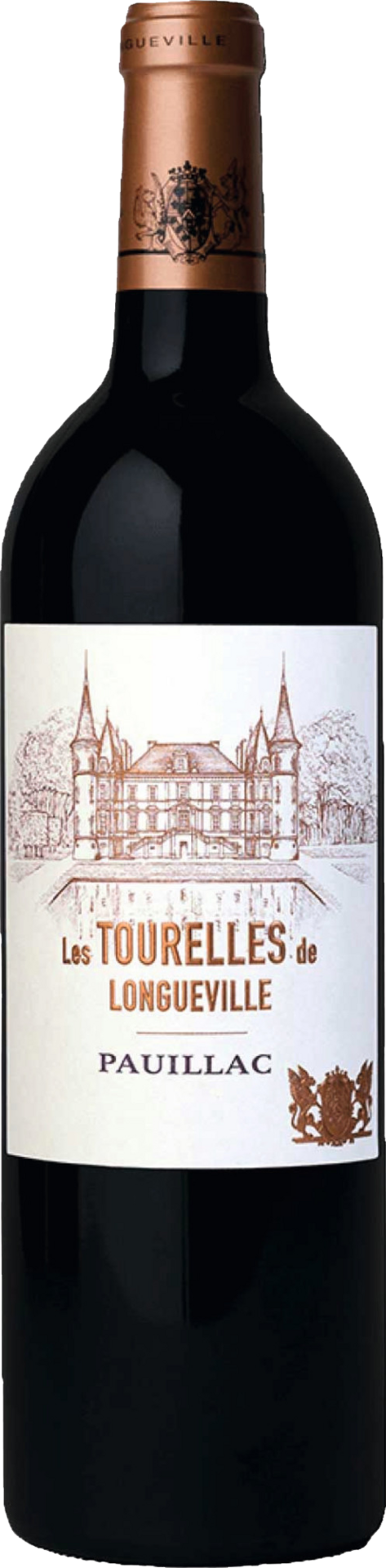
In addition to the Grand Vin, the estate produces two second wines: Les Tourelles de Longueville, in the range since 1983, comes from plots with more clayey soils and is Merlot-dominant — more accessible in style, with a softer mouthfeel and an aromatic profile that is more reminiscent of the wines of the Rive Droite. Les Griffons de Pichon Baron, introduced in 2012, takes a more classic Pauillac course with a higher Cabernet Sauvignon content: floral profile, black berry fruit, firm structure. All three wines consistently reflect the estate's terroir — Pichon Baron is Pauillac without compromise.