From the Parliament of the Bordelais to the 1855 Classification
The roots of Château Lafon-Rochet reach back to the early 17th century. In 1650, Antoinette de Guillemotes brought the estate known as "Domaine de Rochet" as a dowry into her marriage with Étienne de Lafon, a parliamentary councilor of the Gironde — and thus gave the Château its double name, which remains valid to this day. The Lafon family retained ownership for more than two centuries, even through the turmoil of the French Revolution. In 1855, when Napoleon III had the Grands Crus du Médoc classified for the Paris World's Fair, Lafon-Rochet was ranked as a Quatrième Grand Cru Classé — a rank that has remained unchanged ever since.
What followed was a slow decline: phylloxera, changing owners, lack of investment. When Guy Tesseron acquired the estate around 1960, the vineyards and buildings were in such poor condition that a complete reconstruction of the Château was necessary. Tesseron had a manor house built in the style of the 18th century and painted it a bright yellow — Lafon-Rochet is thus the only classified Médoc Cru whose main building was completely rebuilt in the 20th century. Michel Tesseron continued to manage the estate in the second generation, and his son Basile joined the management in 2007. At the end of 2021, Jacky Lorenzetti, already the owner of Château Lilian Ladouys, Château Pédesclaux, and Château d'Issan, acquired the winery and has been managing it ever since.
Parcel thinking, agroforestry, and the influence of Pétrus
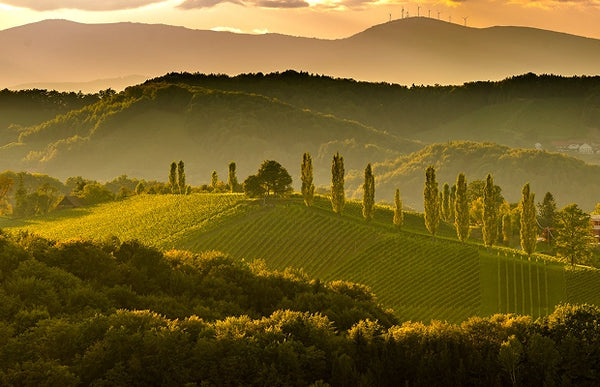
The contiguous vineyard covers around 45 hectares between Château Lafite-Rothschild and Cos d'Estournel — an extraordinary location whose soils consist of Quaternary gravel over deep clay. Parts of the subsoil exhibit the same blue clay that is also found in Pomerol. It is therefore no coincidence that Jean-Claude Berrouet, the long-time cellar master of Château Pétrus, was recruited as the first left-bank consultant for Lafon-Rochet. The vineyard is planted with around 55% Cabernet Sauvignon, 38% Merlot, as well as portions of Cabernet Franc and Petit Verdot; the oldest Merlot parcels date back to 1938.
In the vineyard, Lafon-Rochet is committed to the transition to biodynamic farming, without chemical-synthetic pesticides. Under Basile Tesseron, an agroforestry project was also implemented: almost 5,000 vines were grubbed up and around 6,000 trees were planted. In the cellar, work is done on a parcel-by-parcel basis: 40 clearly defined vineyard parcels are vinified separately — in a combination of concrete vats (Cabernet Sauvignon) and stainless steel tanks (Merlot, Cabernet Franc, Petit Verdot). Hand-harvesting by an experienced team is standard, and optical sorting technology complements quality control in the cellar.
Saint-Estèphe character with depth and structured elegance
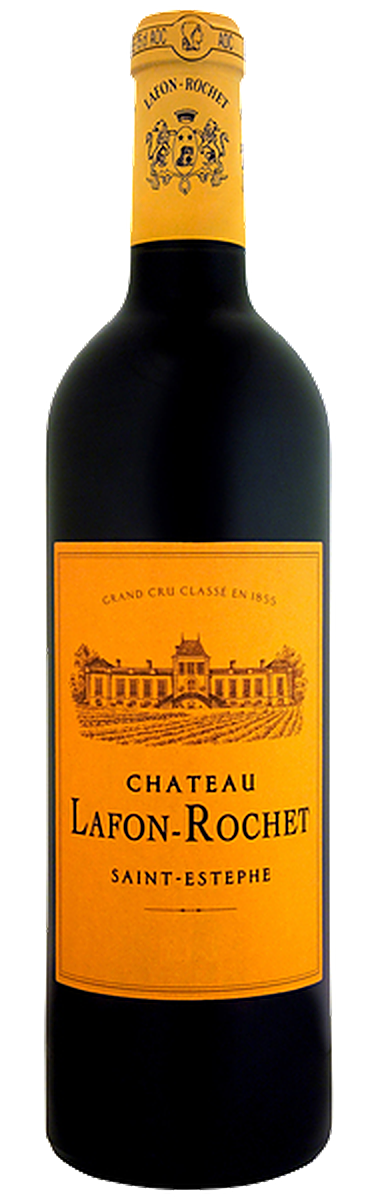
The wines of Château Lafon-Rochet carry the typical profile of their appellation: dark fruit, cassis aromas, licorice, and spice notes, supported by a firm tannin structure shaped by the high Cabernet content. The high Merlot content — above average for Saint-Estèphe — brings fullness and a silky texture that cushions the austerity of the Cabernet. The Grand Vin comes exclusively from the oldest parcels with the most complex subsoils; the second cuvée, Les Pèlerins de Lafon-Rochet, comes from younger vines on predominantly clay and gravel-rich soils and offers a more accessible entry into the house style. Both wines are aged in barriques, the Grand Vin for between 16 and 20 months depending on the vintage, with a new wood proportion of 50 to 60%. Hearty braised dishes, leg of lamb with herbs of Provence, or aged hard cheese are recommended pairings.