From gravel hill to Maharaja castle
The history of Cos d'Estournel begins on a hill of gravel. “Cos” means gravel hill in the Gascon dialect. Louis-Gaspard d'Estournel, a horse and wine merchant, inherited vineyard land there in 1791 and gradually bought more parcels. 1811 is considered the founding year of the winery. He preferred to sell his wines directly to customers instead of through merchants and sent them as far as India.
Bottles that came back unsold often appeared more expressive after the sea voyage. They received an “R” for “Retour des Indes”. His love for the Orient earned the founder the nickname “Maharaja of Saint-Estèphe”. To this day, it characterizes the château with pagoda towers, elephant motifs and a wooden door from Zanzibar. In 1855, Cos d'Estournel was classified as a Deuxième Cru Classé. Later, the estate belonged to the Charmolüe family and from 1917 Fernand Ginestet. Afterwards, his grandson Bruno Prats managed it until 1998. Since 2000, it has belonged to the entrepreneur Michel Reybier.
Parcel work, gravity cellar and organic certification
The vines stand on the southern edge of the appellation, near the border with Pauillac. The vineyard area is around 91 hectares, planted with about 60% Cabernet Sauvignon and 40% Merlot, plus small parcels of Cabernet Franc and Petit Verdot. In total, there are 61 parcels. The team picks them separately according to soil, vine age and location and vinifies each variety separately.
For this purpose, Reybier, together with the architect Jean-Michel Wilmotte, built a cellar that was completed in 2008 and does not require pumps: the must moves solely by gravity. Since 2024, the winery has been certified organic.
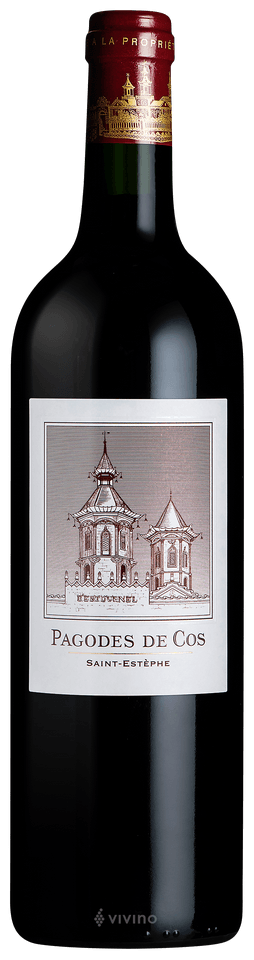
Les Pagodes de Cos: the second wine as an introduction to the Cos style
Les Pagodes de Cos has existed since the 1994 vintage. The wine was originally called Marbuzet, after the location of the same name from which most of the grapes came. Today, it comes from specially selected parcels with vines that are on average 40 years old. The Merlot grows on cooler clay-limestone soils, ripens later and brings freshness to the cuvée. The proportions change depending on the vintage. In 2022, it was 50% Cabernet Sauvignon, 49% Merlot and 1% Cabernet Franc.
In the glass, it shows dark cherry and plum, plus spice and herbal notes. On the palate, it is medium to full-bodied, with fine tannins, mineral pull and a long, spicy finish. Serve it at 16 to 18 °C. It goes well with lamb chops, roast beef or mature hard cheese. There is also a white Pagodes de Cos Blanc made from Sauvignon Blanc and Sémillon.