From the defensive tower in Soussans to the Lurton family's Margaux estate
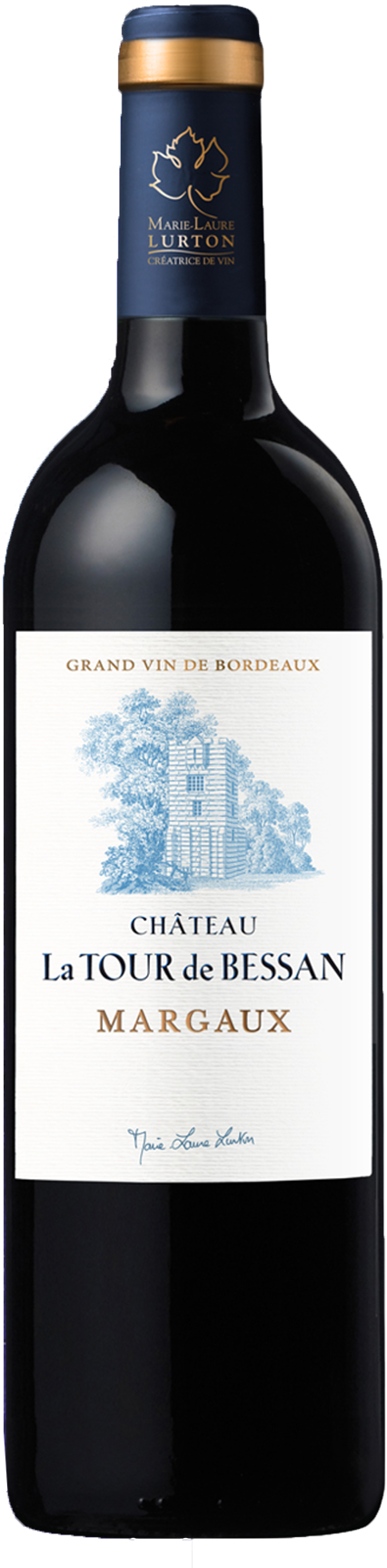
The history of La Tour de Bessan begins in the 13th century with a tower in Soussans. It protected the lord Jehan Colomb when he stayed on his lands. It remained in the Colomb family until 1390. Several families of the region followed, including the Durforts, the Garros, and from 1488 the Seigneurs de Mons. Their last heiress, Thérèse, married the son of the writer Montesquieu in 1740. Only remnants of the tower remain today.
In 1972, Lucien Lurton bought the tower and vineyards from the Clauzel family and developed the property into a winery. In 1992, his daughter Marie-Laure Lurton, an oenologist, took over the Château. She still runs it today, together with Château de Villegeorge. With the Cru Bourgeois classification of June 2003, the estate received official status as a Cru Bourgeois.
Terra Vitis, plot work and a cellar in the former telecommunications building
The vines are located in three municipalities of the Margaux appellation: Soussans, Arsac, and Cantenac. The soil consists of deep gravel deposits, the Pyrenean Graves. The vines are on average about 25 years old and are planted densely with 6,660 to 7,760 vines per hectare. Since the 2003 vintage, the vineyard has held the Terra Vitis certificate, which stands for sustainable viticulture and has been regularly renewed since then. Eric Boissenot works as a consultant.
Harvesting and vinification are carried out plot by plot. The must remains on the skins for 18 to 22 days, after which the wine matures in French oak barrels. For the 2021 vintage, it was 30% new wood; the duration of barrel aging depends on the vintage. The cellar has an unusual history: in 1999, Marie-Laure Lurton, together with architect Vincent Defos du Rau, had a decommissioned 1934 telecommunications building converted into a winery. Since the 2024 harvest, the team has been working in a renovated cellar. In 2020, the historic tower was also restored.
Margaux style: red fruit, violets and fine tannins
The Grand Vin is assembled from Merlot and Cabernet Sauvignon, supplemented by smaller proportions of Petit Verdot and Cabernet Franc. The blend changes depending on the vintage. In 2021, Cabernet Sauvignon and Merlot were almost on par; in 2020, Merlot dominated. Stylistically, the wine stands for finesse rather than power: aromas of red fruits, peony, and violets, plus finely woven tannins. Depending on the vintage, critics also note dried herbs, cedarwood, and licorice. The Guide Hachette awarded the 2018 vintage two stars and a Coup de Cœur.
Serve it at 17 to 18 °C. It goes well with rack of lamb, beef, and game, or with aged hard cheese.