Two thousand years of wine history in the Massif d'Uchaux
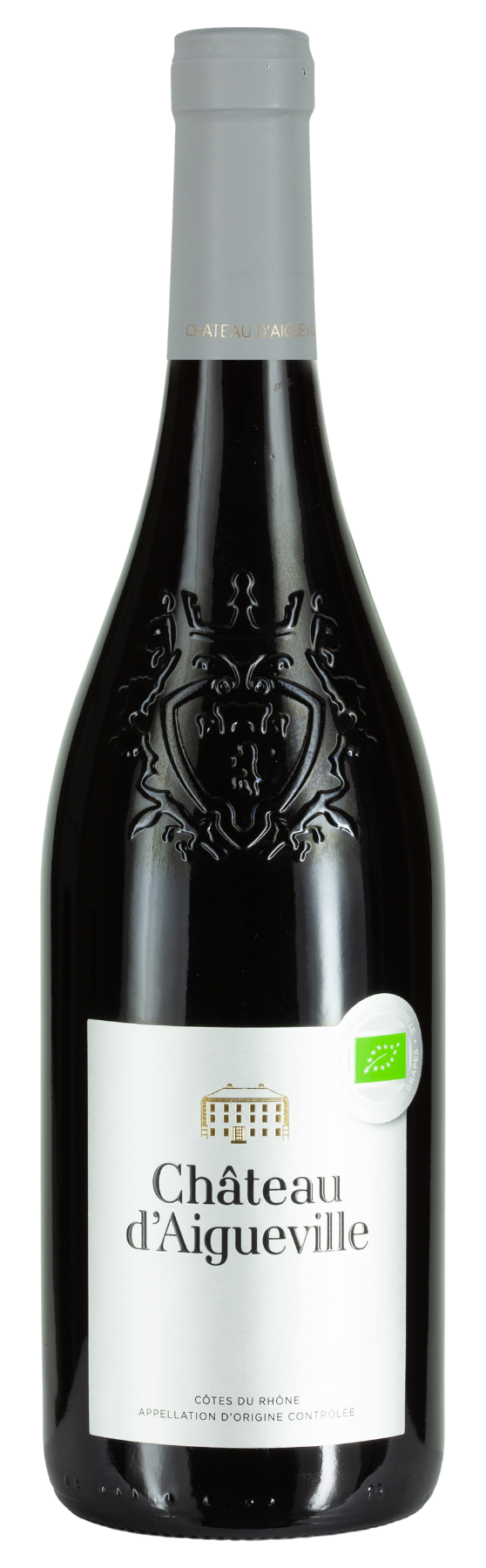
Five kilometers north of Orange, nestled between the hills of the southern Rhône Valley with a view of Mont Ventoux and the Dentelles de Montmirail, lies Château d'Aigueville – an estate whose viticultural history dates back two thousand years. The 19th-century manor house stands in the middle of the vineyards near the village of Uchaux and belonged to the Arène and Paillone families for several generations. Today, the Château is part of the Schenk Family Holding and is supported in its viticulture by the Coulon family – owners of the renowned Domaine de Beaurenard in Châteauneuf-du-Pape. This connection shapes the oenological profile of the estate to this day.
Ecological viticulture on living soil
The entire estate comprises 100 hectares of vines, five hectares of olive groves, and 15 hectares of forest – a contiguous piece of cultural landscape that combines vineyards, pine trees, and garrigue into an ecosystem. Of this, 37 hectares belong to the Massif d'Uchaux appellation, making Château d'Aigueville the largest single producer of this sub-appellation with around 20 percent of the area. The entire operation is certified organic by Ecocert. The Mediterranean climate with plenty of sun and cooling winds creates conditions under which the vines can ripen healthily without relying on additives.
The soils alternate depending on the plot between limestone clay and sandstone, covered by alluvial pebbles – a terroir that closely resembles the famous Châteauneuf-du-Pape. On the red clay soils, the vines develop a particularly aromatic profile. According to the estate, an underground historical spring additionally stimulates soil activity. The plots are located at altitudes between 100 and 250 meters and are separated from each other by garrigue and olive groves – islands in the middle of a wild landscape.
Juicy reds, fresh whites – a clear style from the south
For the red wines, Grenache, Syrah, Carignan, Mourvèdre, and Cinsault are used. For the whites, Clairette, Viognier, Grenache Blanc, Roussanne, and Bourboulenc are grown. Aging depends on the cuvée: for the Villages line, the wines mature 70 percent in wooden barrels and 30 percent in concrete tanks. The simpler Côtes-du-Rhône line is aged exclusively in concrete tanks, which gives the fruit profile directness and freshness. The result is wines that remain focused on the terroir of the Massif d'Uchaux: red and dark fruits, garrigue spice from thyme, rosemary, and bay leaf, plus a salty finesse in the finish that is characteristic of the soils of this hill massif.