Founded before the appellation: How winemakers from Courthézon helped invent Châteauneuf-du-Pape
The Cellier des Princes has existed since 1925 — and thus even a few years before the Châteauneuf-du-Pape appellation was officially founded. What is now the only wine cooperative within the Châteauneuf-du-Pape area began as an association of winemakers who dared to make a fresh start together after the devastation of phylloxera and the bloodletting of the First World War. Solidarity and mutual support were not just empty words from the beginning, but the economic foundation. When the Châteauneuf-du-Pape appellation was established in 1936 as France's first controlled designation of origin, the winemakers of the Cellier had already been working for over a decade to define the standards.
The cooperative has carried its current name since 1960 — in reference to the medieval Princes of Orange, who shaped Courthézon and the surrounding land from the 12th to the 18th century. Their legacy: rigor and loyalty to their origin, values that the winemaker families still claim for themselves today. A decisive turning point came in 2005: at that time, the Cellier completed the transition from bulk wine sales to bottled wine marketing — a strategic break that increased production from 300 bottles to more than two million bottles today.
600 hectares, hand-harvesting, and an oenologist for the Rhône Valley
Around 600 hectares of vineyard area extend over the terroirs of Châteauneuf-du-Pape and the neighboring municipalities of Sarrians, Courthézon, and Orange. The soils are diverse: large rounded pebbles that store heat, sandy and calcareous zones, as well as clay-gravelly hilltops — each site gives the wines a different character. In the cellar, the rule is: what was consistently started in the vineyard should not be leveled by rough interventions. For the Côtes-du-Rhône cuvées, the grapes are largely harvested by hand, based on the harvesting practices of the Châteauneuf sites. Whole grapes, gentle pressing, temperature control during fermentation — the goal is freshness and varietal purity without effort for its own sake.
In 2017, the collaboration with Philippe Cambie, an oenologist specializing in the southern Rhône Valley, began. His outside perspective has accelerated the quality course that was set in 2005. Today, the share of bottled wines is around 96% of total production. Sustainability is not a marketing term here: waste sorting, recyclable packaging, water-saving operations, and a 1,100-square-meter photovoltaic system on the roof — with an annual saving of around 142 tons of CO₂ — are documented measures.
From Côtes du Rhône to Châteauneuf-du-Pape: southern Rhône Valley in breadth and depth
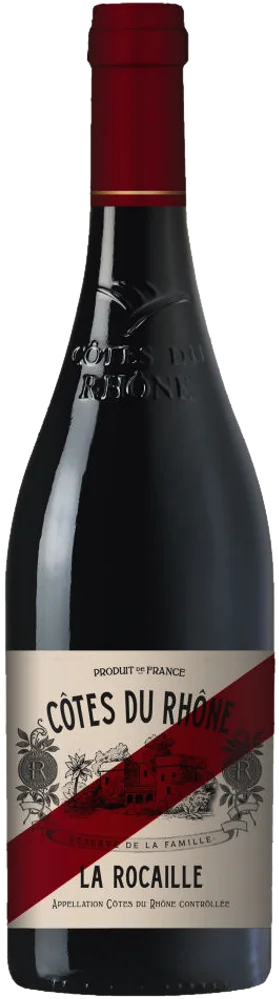
The range of the Cellier des Princes extends from IGP Vaucluse and Méditerranée to Côtes du Rhône and Côtes du Rhône Villages to the top appellations Châteauneuf-du-Pape, Gigondas, Vacqueyras, Cairanne, and Rasteau. The main grape varieties are Grenache, Syrah, and Mourvèdre, supplemented by a wide spectrum of old southern French varieties — in Châteauneuf-du-Pape, there can be up to thirteen grape varieties in one cuvée. The wines deliberately reflect the terroir differences: power and spice from the sandy soils, structure from the limestone sections, fullness and melt from the clay-gravelly slopes. Anyone who has our La Rocaille Côtes du Rhône AOC in the glass is drinking a wine that is created according to the same artisanal principles as the great cuvées of the cooperative — with hand-harvesting, varietal selection according to terroir, and a cellar that has consistently focused on quality instead of quantity since 2005.