From pioneer expedition to high-altitude benchmark
The history of Terrazas de los Andes begins in the early 1990s, when the French agricultural scientist and oenologist Hervé Birnie-Scott was sent to Argentina by Moët Hennessy – with the mission to unlock Mendoza's potential for still wines that would complement the sparkling wine house Chandon Argentina. Armed with an old altimeter, he explored the Andean slopes long before the Argentine wine scene knew the power of altitude. In 1992, the first plantings began in Gualtallary, and in 1996, the bodega was officially founded – in the restored La Perla winery in Perdriel, Luján de Cuyo, which dates back to a Spanish facility from 1898. Today, Terrazas de los Andes belongs to the LVMH group and is under the leadership of Estate Director Lucas Löwi with a team that consistently continues the pioneering work of the founding years.
Altitude as a craft: Terroir, water, and regenerative viticulture
The heart of Terrazas' work is a mosaic of over 200 individual high-altitude plots on around 500 hectares – distributed across Luján de Cuyo and the Uco Valley, between 980 and 1,650 meters above sea level. The winery was the first in Argentina to introduce drip irrigation and today irrigates all sites precisely with glacial water from the Andes. On a large part of the vineyard area, work is done without herbicides, and more than half of it is organically certified. The term "Guardians of Mountain Life" summarizes their self-image: protecting the fragile ecosystem of the high Andes, not just using it. Terrazas is also a co-founder of the "Glaciers for Life" program for the preservation of Andean water reserves.
The philosophy behind it is clear: with increasing altitude, night temperatures drop, solar radiation becomes more intense, and the thermal amplitude grows – this slows down ripening, sharpens the aromatics, and ensures natural freshness in the wine. Each site brings its own soils: sandy loam with gravel in Los Aromos, heavy soils with old vine structure in Las Compuertas, volcanic soils in the highest vineyard El Espinillo in Gualtallary at 1,650 meters.
Malbec, Cabernet, and more: what defines the wines of Terrazas
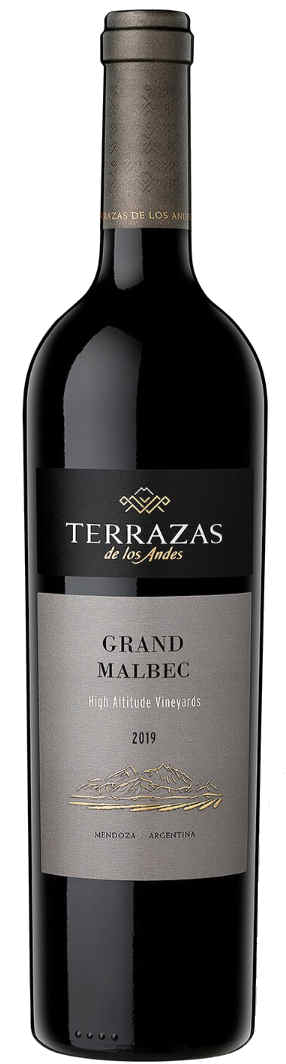
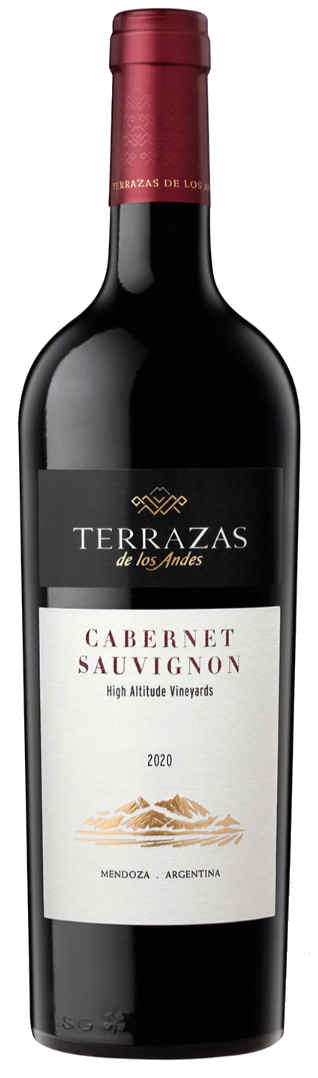
In the range, you will find wines from the most important grape varieties of Mendoza – Malbec and Cabernet Sauvignon as the core, plus Chardonnay. The flagship Grand Malbec is created from an assemblage of the best high-altitude plots: Las Compuertas (1,070 m), Los Castaños in Paraje Altamira (1,100 m), and Licán in Los Chacayes (1,200 m). Maturation takes place in French oak barrels. The result: dark fruit, firm but polished tannins, invigorating acidity, and a long finish – not a heavy blockbuster, but a Malbec with contour. The Cabernet Sauvignon from Los Aromos shows the continental imprint of the Perdriel soils: herbal, structured, with depth. The Chardonnay reflects the mineral coolness of the high altitudes. Those who want to get to know Argentina beyond the warm valley floor style will find wines here that show what altitude and a consistent focus on terroir can get out of one of the most famous wine regions in South America.