From 1254 to today: a site with a long history
The market town of Siegendorf in Burgenland, about 60 kilometers south of Vienna and just a few kilometers from the Hungarian border, was first mentioned in documents in 1254 — and viticulture has demonstrably been practiced here for much longer. The Lenz Moser winery has been managing this special estate since 1988. Lenz Moser is an Austrian wine history in itself: Prof. Lenz Moser III (1905–1987) is considered one of the most important innovators of Central European viticulture and, starting in 1928, developed the high-culture training system named after him, which characterizes the Klosterkeller today.
A single vineyard, two plots, a clear credo
What has distinguished the Klosterkeller Siegendorf from the very beginning is the cohesion of its cultivation area: 24 contiguous hectares — about 2000 meters long and in places only 70 to 150 meters wide — form one of the largest single vineyards in Austria in terms of area. The vineyard is divided into the two plots Dora Dülö and Urasagi Puszta, is slightly inclined to the south-southwest, and is planted with more than 600 vertical rows according to the Lenz-Moser high-culture system. The Pannonian climate, the proximity of Lake Neusiedl, and the warm, sandy-humus soils create ideal conditions for full-bodied red wines.
The site has been managed for decades according to the principle of quality before quantity: organic fertilization, living soil, and a consistent renunciation of mass yields. Harvesting is done exclusively by hand, and only when the grapes are physiologically fully ripe.
Bordeaux grape varieties, Burgenland character: the wines of the Klosterkeller
Until 1990, the single vineyard was planted entirely with Cabernet Sauvignon (11 ha), Cabernet Franc (3 ha), and Merlot (7 ha) — with Pinot Blanc (3 ha) as the only white grape variety. With around 87 percent red wine grapes, the estate is one of the most red-wine-focused businesses in Austria. The vines have now reached the age where they produce concentrated, structured grapes.
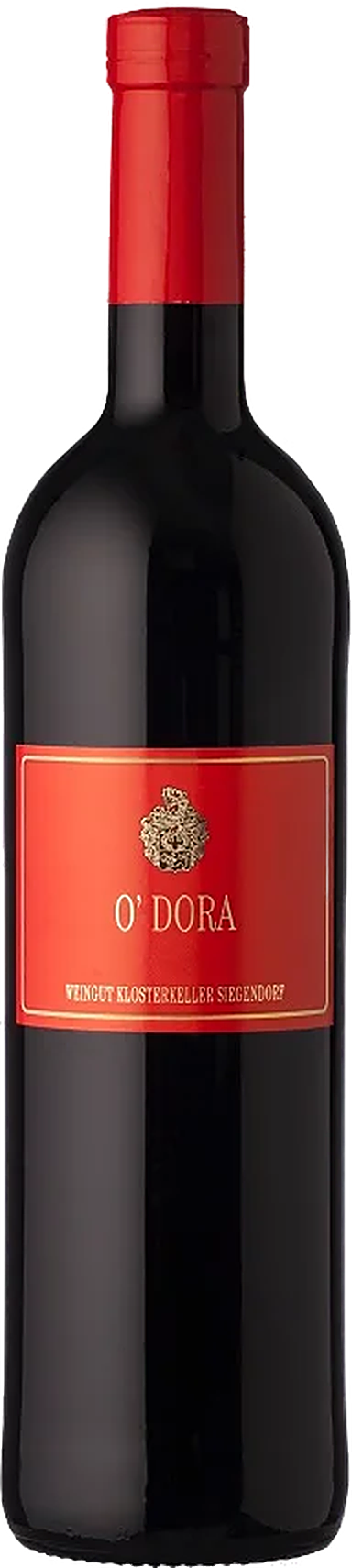
The flagship is the Cuvée O'Dora — the name says it all: O' stands for Opus, meaning "the work," and Dora refers to the origin plot. After temperature-controlled mash fermentation, the cuvée of Cabernet Sauvignon and Cabernet Franc undergoes malolactic fermentation in barriques; it then matures for about 16 months in new Allier oak. The result: dark berry fruit and delicate cassis notes on the nose, hints of tobacco and roasted aromas, a full body with firmly integrated tannins, and a long finish. Anyone looking for Burgenland red wine with classic Bordeaux DNA will find one of the most consistent addresses in the country here.