From Alsace to Provence: How Marcel Ott shaped three terroirs
The history of Domaines Ott begins in 1896, when the agricultural engineer Marcel Ott moved from Alsace to Provence — to a region that was just reinventing itself after the phylloxera devastation. 1912 he acquired his first property with Château de Selle in Taradeau, a former estate of the Counts of Provence on barren hills twenty kilometers from the coast. On arid soils of gypsum, red clay and sandstone, he began to plant grape varieties such as Grenache, Cinsault and Mourvèdre and to develop his own style step by step. 1936 followed Clos Mireille — a 174-hectare area directly on the Mediterranean in La Londe-les-Maures, on slate and quartz soils, today surrounded by a nature reserve. 1956 the family completed the trio with Château Romassan in Le Castellet, in the middle of the Bandol AOC. Since the name suffix Domaines (plural) has been used, the idea of the association of three independent terroirs has been at the center — not one large, uniform winery, but three characters under a common ambition.
Since 2004, the domains have belonged to the Roederer Group, but are still managed independently by Jean-François and Christian Ott, cousins of the fourth generation. The family signature is thus preserved — combined with the resources of one of France's most renowned wine companies.
Organic since 2022, artisanal since foundation
What Marcel Ott began as yield-reduced viticulture is today cast in a clear structure: Since the 2022 vintage, all three domains have been officially organically certified. In the vineyards, planting is dense, the yield is strictly limited, and synthetics are completely avoided. At Château Romassan, the winemakers work in the vineyard with the Gobelet training, in which each vine is guided individually on a stake — a system that gives the vines maximum independence and transfers the soil character directly into the fruit. Harvesting is done exclusively by hand, the grapes are delivered cooled in 300-kilogram crates and gently pressed whole the next day — short maceration time, careful fermentation in steel tanks or barrels of various sizes, regular stirring of the yeast over the winter. The Bandol Rouge matures for 18 months in wood and subsequently for up to 24 months in the bottle. Each domain has its own cellar; the cellar of Château Romassan was modernized in 2023 to enable even more precise work.
Three addresses, three signatures — Rosé as a common thread
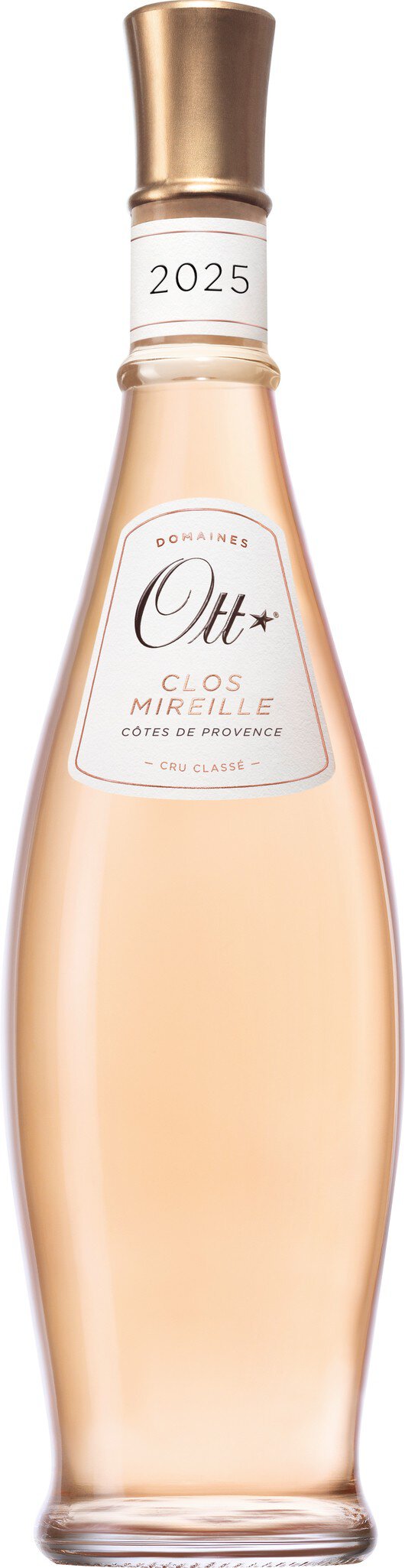
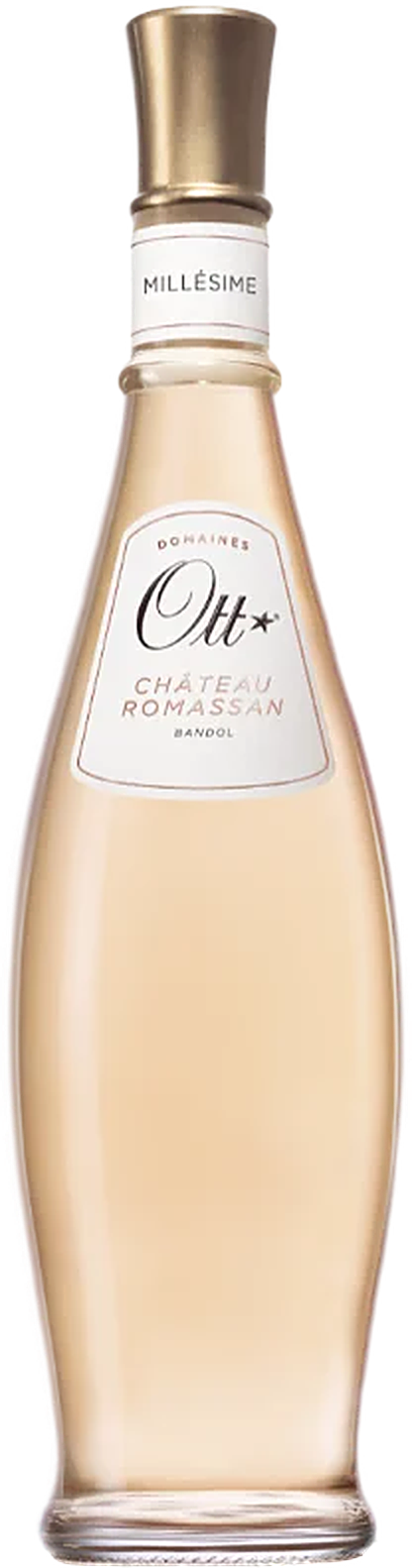
Rosé is the backbone of the assortment, but not the only expression. Château de Selle, on mineral-dry limestone soils in the hinterland, delivers linearly structured wines with fine minerality. Clos Mireille, where the sea air pulls directly into the slate soils, stands for salty freshness and a white Blanc de Blancs made from Sémillon and Rolle, which belongs to the rarity of the appellation. Château Romassan in Bandol shows the more muscular face of Provence: Mourvèdre dominates the Rosé and the Rouge, provides structure, depth and red-berry fruit with a hint of garrigue and licorice in the finish. The Étoile cuvée — as Vin de France without an appellation corset — combines grapes from all three terroirs into a free composition that is considered the distillate of the house. The characteristic amphora bottle, designed by René Ott in 1932, is not a mere design detail: It refers to the millennia-old viticulture history of Provence and is now an identifying mark itself.