From monastic cell to the Schenk family estate
The name Château de Châtagneréaz recalls the chestnut forests that once covered large parts of the Côte on Lake Geneva. The oldest written evidence of vines on the estate dates back to the year 996, while the first surviving walls of the château date from 1177. Shortly thereafter, the property passed to the Abbey of Lac de Joux, whose monks cultivated wine for almost two centuries under the protection of the de Grandson-La Sarraz family. After the Reformation, the abbey disappeared and the estate fell under Bernese rule until it changed hands again at the end of the 18th century.
After the Second World War, the then-owners of the château sought a partner to restore the building – they found one in Arnold Schenk, who invested over 25 years in the reconstruction and eventually became the sole owner. To this day, Château de Châtagneréaz belongs to the Schenk wine-growing family, who manage it as an independent estate in the heart of Mont-sur-Rolle.
Loam soils and hand-harvesting: working in the vineyard and cellar
The vines are situated on one of the best-exposed sites of the Côte, on heavy, loamy-clay soils made of stone-poor moraines – a subsoil that gives the Chasselas structure and fruit. The vines are planted in narrow rows and high density, and are harvested by hand.
In the cellar, the wines mature in large wooden vats, the traditional vases de bois of the Vaudois winemakers. The ceiling of the historic vaulted cellar bears names, initials, and years that coopers and winemakers have burned in with candle flames over generations – a ritual that makes the connection to the place visible. In recent years, the estate has also embarked on the path towards organic farming.
Chasselas as a flagship: the range
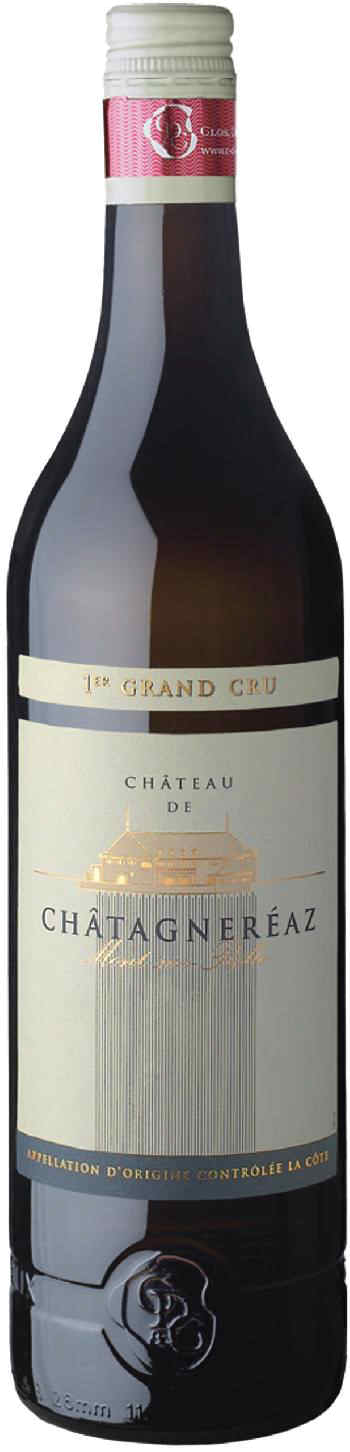
Three wines form the core range: a Chasselas 1er Grand Cru, a Viognier, and a red blend of Gamay d'Arcenant, Gamaret, and Garanoir. The Chasselas bears the 1er Grand Cru classification – the highest category of Vaudois wines, introduced in 2012 and reserved for only a few Chasselas wines in the region. In the glass, it is floral and mineral with notes of linden blossom and a hint of citrus; on the palate, it is powerful and dense with a solid structure that also allows for a few years of aging.
The Viognier, only planted in the 2000s, is vinified without malolactic fermentation to preserve tension and apricot aromas, and matures in third and fourth-fill barrels. The red blend presents itself in ruby red with violet reflections; the bouquet is reminiscent of red berries and dark cherries, with round, soft tannins on the palate. The Chasselas is best enjoyed at 10–12 °C as an aperitif, with fish dishes from Lake Geneva, or with Gruyère and Vacherin Mont d'Or, while the red cuvée goes well with pork dishes.