From the family land of explorers to the island's oldest Madeira house
The roots of Casa dos Vinhos da Madeira reach back to the 15th century: the Henriques family had been among the largest landowners around Câmara de Lobos since that time — exactly where, according to legend, the first vines of Madeira were planted. The formal start of the company was made in 1850 by João Gonçalves Henriques, who initially ran the firm as a so-called Partidista: he supplied other merchants with wine from the extensive family stocks while simultaneously building up significant storage reserves of old vintages. After his death in 1912, his sons João Joaquim and Francisco Eduardo Henriques took over and founded the partnership from which the name Henriques & Henriques emerged.
In 1932, this resulted in the brand Casa dos Vinhos da Madeira — founded as an independent company that continues the family's legacy in a consolidated form. Between 1937 and 1946, three more partners joined, including Peter Cossart, whose name is still associated with the house today. 1992 saw a decisive modernization step: a new aging cellar building in Câmara de Lobos and its own vinification center in the Quinta Grande district, which secures production at a contemporary technical standard without letting go of the long family tradition.
Own vineyards, Canteiro aging, and full control from the slope to the bottle
What distinguishes Henriques & Henriques — and thus Casa dos Vinhos da Madeira — from most other Madeira houses: the company owns its own vineyards, a rarity on the island where the majority of grapes are traditionally purchased. The main estate in Quinta Grande is located at an altitude of 600 to 700 meters above sea level and covers about 10 hectares. Further plots are located in the sub-regions of Estreito de Câmara de Lobos and São Vicente. This control over the entire production path — from the vineyard through fermentation to aging — is the foundation of the quality standard.
Madeira's soils are of volcanic origin, predominantly basaltic, low in potassium, and rich in iron and phosphorus — this mineral structure contributes directly to the concise acidity that characterizes all the house's wines. Aging is carried out according to the traditional Canteiro process: the barrels are stored in the upper, warmer floors of the warehouse and moved downwards over the years, where it is cooler. This slow temperature change is the core of Madeira aging — it creates the characteristic oxidation and concentration that is unique to no other wine type in the world.
Sercial to Malvasia: a range that shows the full depth of Madeira
The range spans from dry styles to deep golden sweet wines. The four classic white grape varieties — Sercial, Verdelho, Bual, and Malvasia (Malmsey) — form the backbone: Sercial matures in the coolest conditions, bringing firm acidity and nutty tartness; Verdelho stands for medium dryness with honey notes; Bual provides creamy fullness with dried fruit complexity; Malvasia is the richest, darkest style with caramel, fig, and a long, warm-sweet finish. In addition, there are rarities such as Tinta Negra and the almost forgotten grape variety Bastardo.
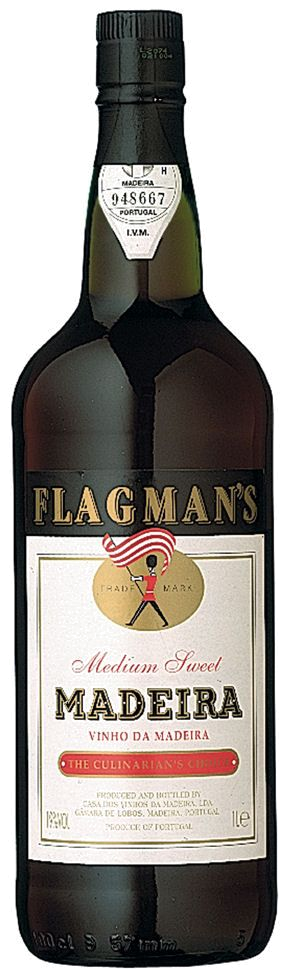
The offer ranges from three-year-old entry-level wines to maturation levels of 5, 10, 15, 20, and 50 years, up to single harvest bottlings (Single Harvest) and old vintages from the Frasqueira stock. The brand Casa dos Vinhos da Madeira carries this spectrum in the export markets: for decades, it has been the market leader in the Canadian province of Ontario and in British Columbia and is also distributed in Belgium. Flagman's Madeira is the entry into this world — a wine that makes the house's artisanal continuity tangible, without needing to be prepared for the table: neat as an aperitif, with boiled potatoes and butter, with mature hard cheeses, or as a companion to dark chocolate.