From Vega Sicilia to Toro: A family project on the wild Duero
The history of Bodegas Pintia begins with a decision that would have far-reaching consequences for the entire DO Toro. In the mid-1990s, after the Álvarez family had already set two benchmarks in the Ribera del Duero with Vega Sicilia and Alión, David Álvarez and his son Pablo were looking for a new terroir. They followed the Duero downstream — about a hundred kilometers west, towards Portugal — and came across Toro: at that time a largely unknown region overlooked by the international wine world. In 1997, the first vineyard purchases began around the village of San Román de Hornija. At that time, Toro was not a discovery in the fashionable sense, but a bet on a terroir that had convinced the family — with old, partly ungrafted vines, pebble areas from old river deposits, and an extreme location at an altitude of around 700 meters. The first vintage appeared in 2001 under the name Pintia.
Pebble terroir, organic cultivation and a hundred attempts in the cellar
Pintia's vineyards are located on alluvial terraces that the Duero has piled up over centuries. Two main plots characterize the operation: Garabitas with deep soils and plenty of gravel in the subsoil, and Los Hoyos, whose rocky surface ensures earlier ripening of the grapes. The continental climate is uncompromising — bitterly cold winters, hot, dry summers with an annual rainfall of only 350 to 400 mm. The vineyards are managed organically, like all sites in the Tempos Vega Sicilia group; herbicides and synthetic fertilizers have no place. Since the Toro region was spared from phylloxera, many of the old vines are still ungrafted today — a stroke of luck that has left vines of extraordinary depth and independence.
In the cellar, Pintia shows the same thoroughness. Before the first wine went on sale, the team tested nearly a hundred vinification and aging variants in four experimental vintages — different vine sites, wood types, maceration and barrel times, malolactic fermentation in the tank or in the barrel. The harvest is done exclusively by hand, the grapes are placed in 12 kg crates, double-sorted after a twelve-hour cold phase, and then cold-macerated. Barrel aging lasts twelve to fifteen months depending on the vintage — predominantly in French and American oak — followed by at least twelve months of bottle aging. In 2018, the bodega was extensively modernized to be able to work even more precisely with smaller tanks, stone amphorae, and egg-shaped granite containers.
A single wine, a single claim: Power with precision
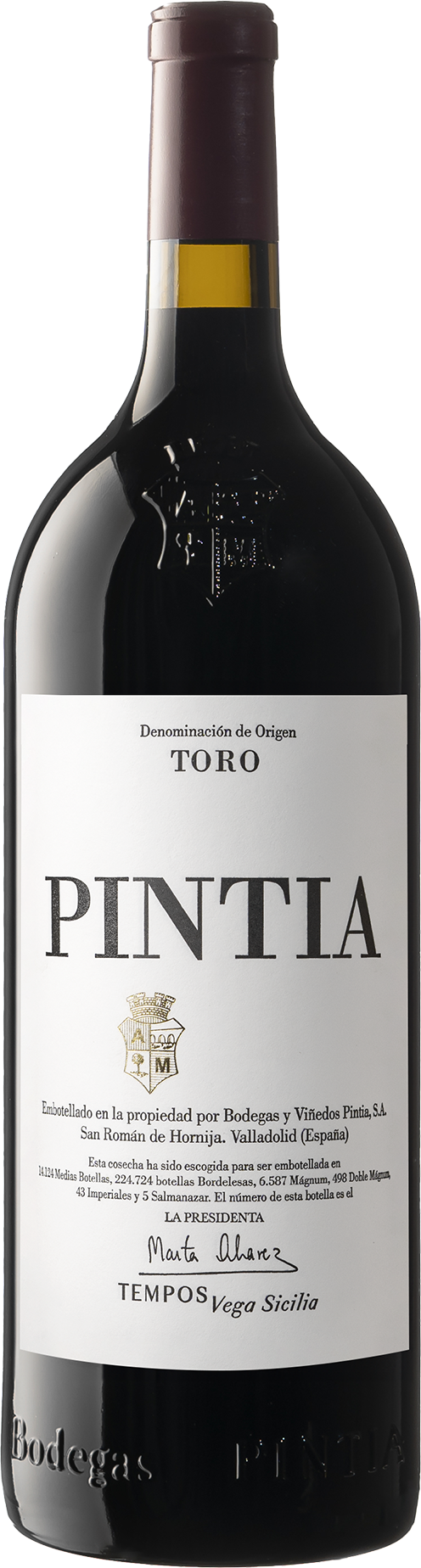
Pintia produces exactly one wine — the principle that the family had already established with Alión. 100% Tinta de Toro, the local clone of Tempranillo with thick-skinned berries and a pronounced tannin structure. The challenge of the terroir is obvious: Toro is warmer than the Ribera del Duero, the grapes ripen faster and reach higher sugar levels. The goal from the beginning was not to show off this power, but to tame it — to preserve the fruit without falling into over-ripeness or licorice dominance, and yet to let the unmistakable density of the plateau be felt. In the glass, this shows as a deep ruby violet with aromas of black cherry, blackberry, and spicy oak, a medium to full-bodied structure, and a long, structured finish. Pintia is available exclusively as a single-vineyard cuvée — in the standard bottle (0.375 l) and as a magnum (1.5 l), which is designed for slower aging and special occasions.