From mixed farm to Burgundy address at the Kaiserstuhl
The Salweys have been cultivating their Kaiserstuhl land since the middle of the 18th century — documented since 1740, initially as a classic agricultural mixed farm with livestock. The foundation for today's wine focus was laid by Benno Salwey, who founded the winery in its current form in 1950. His son Wolf-Dietrich consistently pushed the specialization: he converted the business entirely to viticulture in the 1960s and 1970s, acquired the Rinzberghof in the Glottertal north of Freiburg at the age of just 23, and took over the parental business in Oberrotweil in 1985. After his father's death in 2011, Konrad Salwey has been running the winery alone in the third generation — and has since developed it into a firm reference address in the German Burgundy spectrum. Not insignificant for this reputation: the winery has been a member of the VDP since 1926, the Association of German Prädikat Wine Estates, whose predecessor already laid the foundation for consistent quality orientation at the Kaiserstuhl.
Natural yeasts, selective hand-harvesting, wooden barrels — Konrad Salwey's signature in the cellar
Konrad's training first took him to France, to Zind-Humbrecht in Alsace and to Michel Juillot in Burgundy, before he studied oenology in Geisenheim. This Burgundian influence is still noticeable in the cellar philosophy today: all grapes are harvested exclusively by hand and strictly selectively. In the cellar, Salwey ferments with natural yeasts in large wooden barrels — nature is given space and time without the process being left to chance. Konrad Salwey is known for trying new things and discarding them again if they do not serve the aging process. Wines that do not correspond to the desired terroir expression are corrected — right up to regrafting individual vines. The result is invariably dry wines that are fully fermented and tell directly of the character of their soils.
In the vineyard, Salwey works according to ecological principles: the use of pesticides is largely avoided, natural fertilizers are used, and the management aims to preserve biodiversity in the sites.
Pinot Gris, Pinot Blanc, and Pinot Noir — three varieties, an unmistakable volcanic Kaiserstuhl
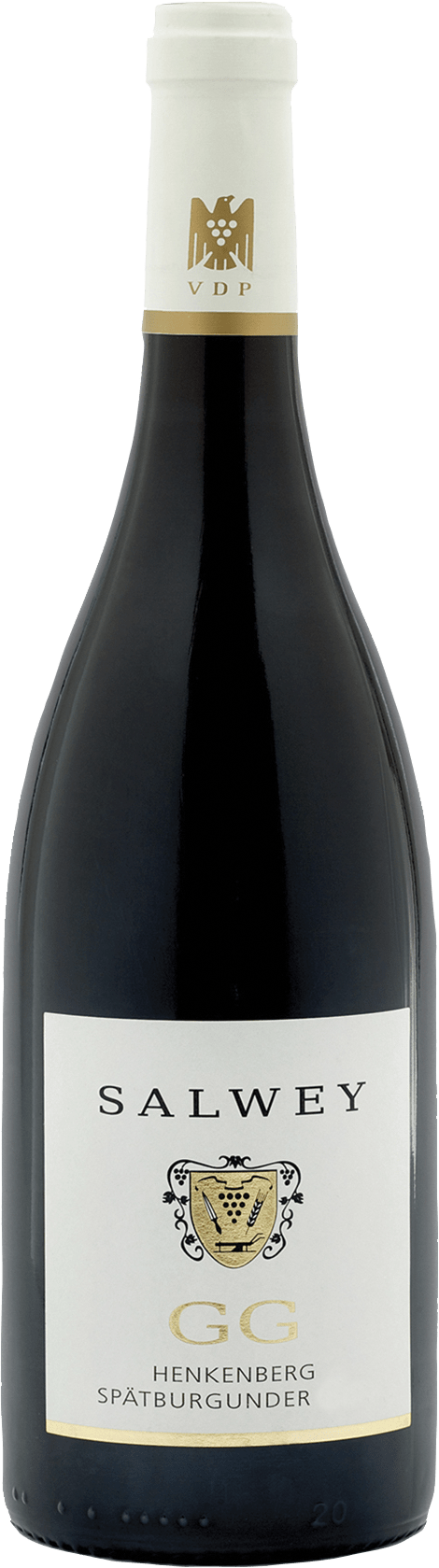
On about 50 hectares of vineyards, Salwey cultivates exclusively the three classic Kaiserstuhl Burgundy varieties: Pinot Gris and Pinot Noir each occupy 40 percent of the total area, Pinot Blanc about 16 percent. The top sites Henkenberg and Kirchberg in Oberrotweil are recognized by the VDP as Grosse Lagen (Grand Crus); the Henkenberg stands on cooled lava soils with limestone inclusions, overlaid by dark volcanic ash — a soil combination that gives the wines a mineral-salty structure that cannot be confused with any other wine-growing region in Germany. In addition, there are vines in the Eichberg (Oberrotweil and Glottertal) and in the Käsleberg, where loess soil creates a softer, fuller-bodied style.
The flagship of the house is the Pinot Gris — in Konrad's own words, his greatest passion. But the Pinot Noir from the Henkenberg also shows what the Kaiserstuhl volcanic soil can do for red wine: structure, depth, and a freshness that is preserved despite the warm sunny location of southern Baden. Anyone who knows the wines of Salwey does not expect light drinking wines — but terroir-driven, age-worthy Burgundies that are worth the time in the cellar.