From Carbost to the world: How the MacAskills founded Skye's only distillery
The name Talisker comes from Old Norse — Thalas Gair, the sloping rock. It would have been hard to name a distillery more fittingly. In 1830, brothers Hugh and Kenneth MacAskill founded the distillery in the village of Carbost, on the shores of Loch Harport, after acquiring the lease from Clan MacLeod. The construction met with resistance from the local minister, who called the new facility a curse — history proved the opposite. After setbacks in the mid-19th century, including the founders' bankruptcy and a succession of changes in ownership, conditions only stabilized towards the end of the century. In 1960, fire damage completely destroyed the brewhouse; the distillery was rebuilt and started up again in 1962. Today, Talisker belongs to the Diageo group and is the oldest still-active distillery on the Isle of Skye — and the only one.
Water from Hawk Hill, worms instead of modern condensers
The water for production comes from the Cnoc nan Speireag Burn, the so-called Hawk Hill, and flows directly over peat deposits — a first aroma-defining step, even before fermentation begins. Until 1928, Talisker worked with triple distillation; then they switched to the double distillation common today. The unusual configuration of two wash stills and three spirit stills is a legacy of this earlier practice. The wash stills are notable for a striking U-shaped bend in the lyne arm, which creates additional reflux and gives the distillate texture and fruit. Instead of modern shell-and-tube condensers, Talisker uses traditional worm tubs — spiral copper coils in cold water — which intentionally reduce the contact between copper and distillate, thus reinforcing the oily, heavy character profile of the new make. Fermentation takes place in wooden washbacks and lasts 65 to 72 hours — long enough to build up fruity, citrusy notes that later balance the smoke. Maturation takes place predominantly in ex-bourbon casks made of American oak; individual bottlings receive a finish in Amoroso sherry casks or port wine casks.
Smoke, pepper, salt — the Talisker profile in the range
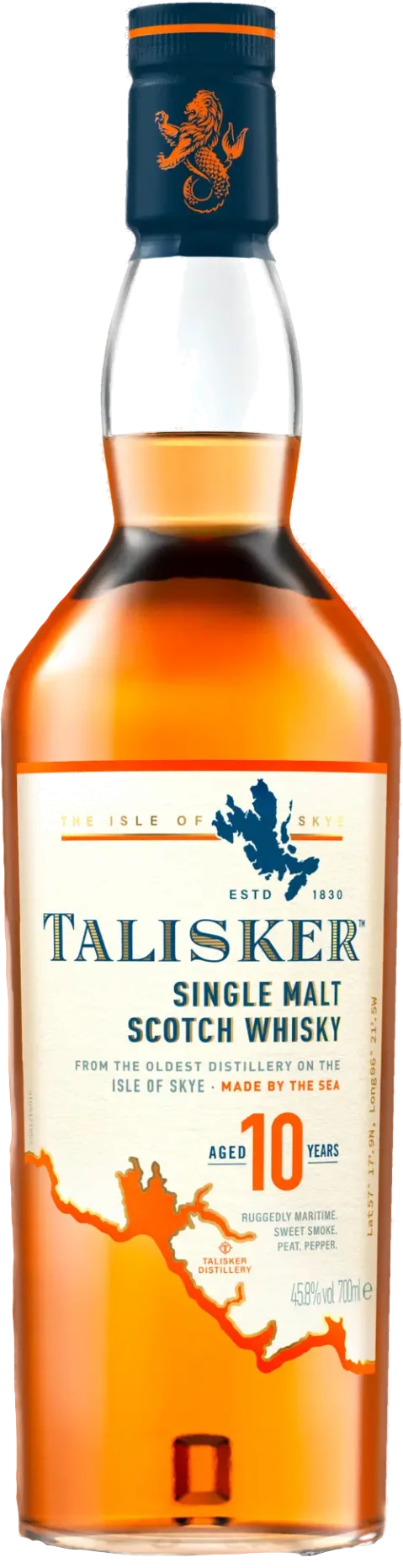
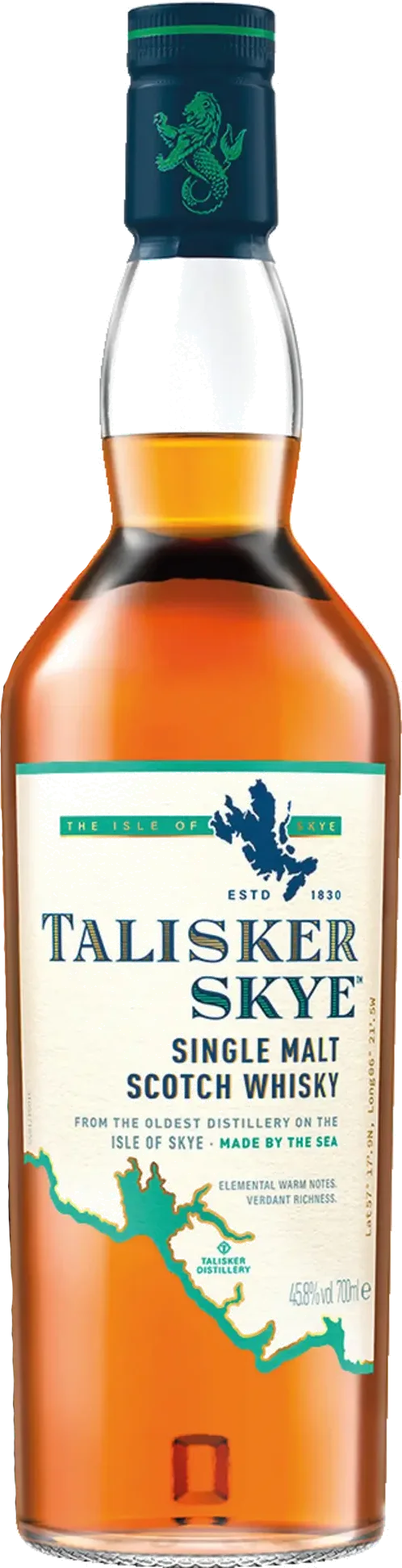
What makes Talisker whisky so recognizable can be traced back to a few precise elements: medium peating (around 25 ppm phenol in the malt), salty sea air during maturation on Loch Harport, and the oily, spicy texture from the worm tubs. The result is a whisky with smoke in the background, a long peppery finish, and a salinity that does not feel intrusive, but rather holds the glass together. The Talisker 10 Years Old is considered the house classic and the benchmark of the maritime island style — aged in ex-bourbon casks, with citrus, sea breeze, and the pepper finish typical of Talisker. The Talisker Skye is more accessible, more lightly smoked, and thus a sensible introduction to the house style. Both show what Talisker has stood for for almost two centuries: whisky that does not deny its place of origin.