From a Belle Époque spa town to a global table drink
The history of Sanpellegrino begins in a narrow mountain valley in Lombardy: San Pellegrino Terme, province of Bergamo, in the Val Brembana. The springs there have been known for centuries — the first written mentions go back a long way, and in 1782 a scientific analysis systematically determined the mineral composition of the water for the first time. On May 21, 1899, the company was officially founded as Società Anonima delle Terme di San Pellegrino, listed on the Milan Stock Exchange. In the founding year, 35,343 bottles were filled — over 5,000 of them shipped directly overseas.
Around the turn of the century, San Pellegrino Terme advanced to become a fashionable spa town for the European aristocracy. The Grand Hotel and the casino in the Art Nouveau style, designed by the Milanese architect Romolo Squadrelli, attracted kings and statesmen. This prestige radiated onto the brand. In 1957, Sanpellegrino acquired the mineral water manufacturer Acqua Panna; by 1970, the company claimed to be the largest beverage manufacturer in Italy. Since 1998, Sanpellegrino has belonged to Nestlé Waters, but has kept its production site in San Pellegrino Terme.
Source, bottling, and a journey of over 30 years through the rock
The water that enters the emerald green bottle under the name S.Pellegrino takes a long journey: it seeps from the Dolomite Alps at an altitude of about 1,200 to 1,300 meters into the ground and takes at least 30 years to reach the source in San Pellegrino Terme through the rock. On this route, it is enriched with minerals that give the fine perlage its characteristic, slightly salty character. Carbonic acid is added to the natural mineral water during bottling.
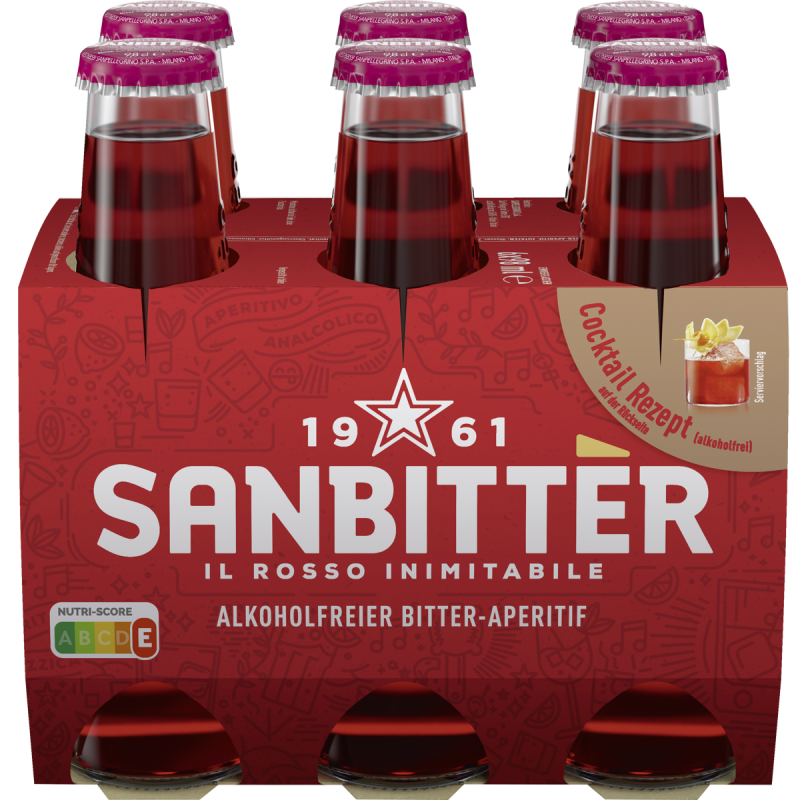
Sanpellegrino has consistently expanded its assortment since its founding years. In 1932, Aranciata came onto the market, followed by Limonata. In 1961, the company launched a non-alcoholic bitter aperitif under the name Bitter Sanpellegrino, which was renamed Sanbittèr in 1985. The recipe — a composition of citrus extracts, herbs, and spices — has remained largely unchanged since then.
Mineral water, bitter soda, and the style of the Italian table
What holds Sanpellegrino together in the assortment is a clear self-image as a table drink: the mineral water with its fine-beaded carbonic acid and balanced mineralization is classically recommended by sommeliers as an accompaniment to food because it neither masks aromas nor competes with strong individuality. The Sanbittèr Aperitivo, on the other hand, fills a different role: ruby red, with a bitter herbal-citrus profile and no alcohol, it has been established in Italian bar culture since the 1960s as an independent aperitivo before meals — neat, ice-cold, directly from the small bottle, or as a base for non-alcoholic cocktails. Today, the assortment is available in more than 100 countries.