From pharmacy recipe to Berlin city brand
Mampe is not a young brand that relies on nostalgia — it has experienced nostalgia itself. In 1831, the secret medical councillor Carl Mampe Senior mixed a stomach bitter in Stargard, Pomerania, to combat the rampant cholera, which he called "Bitter Drops" and sold in pharmacies. What began as a remedy soon moved to the burgeoning capital of Berlin and grew into a liqueur factory. At the company's economic peak, the range included over 70 types of liqueurs, brandies, and spirits, sold in more than 11,000 retail outlets. In 1894, Carl Mampe Junior developed the herbal liqueur Halb und Halb — made from equal parts herbs and bitter oranges — and thus created the product that still forms the heart of the brand today. In their own bars, the so-called Mampe-Stuben, it was served to all levels of Berlin society for just a few pfennigs. After the Second World War, expropriation in the GDR, and a long stopover with large corporations like Doornkaat and Berentzen, Berlin entrepreneurs bought back the brand rights in 2012 — and got production back on its feet themselves.
Transparent manufactory in the Bergmannkiez
Today, Mampe operates in an old factory building in Berlin-Kreuzberg, on Bergmannstraße. The production is deliberately designed to be open: anyone who wants to can look over the shoulders of the manufactory. Behind this transparency lies a clear production principle. All spirits in the manufactory line are based on a regional wheat distillate and are produced one hundred percent by hand — without synthetic additives. The range follows two strict criteria: either a product must have existed in some form in the Mampe range since 1831, or it must have a clear connection to Berlin. New ideas without a historical or local anchor simply do not make it into the program. In the meantime, an exhibition area has also been created in the manufactory with objects from almost two centuries of company history — a living archive of Berlin schnapps culture.
Classics, gins, and Berlin peculiarities
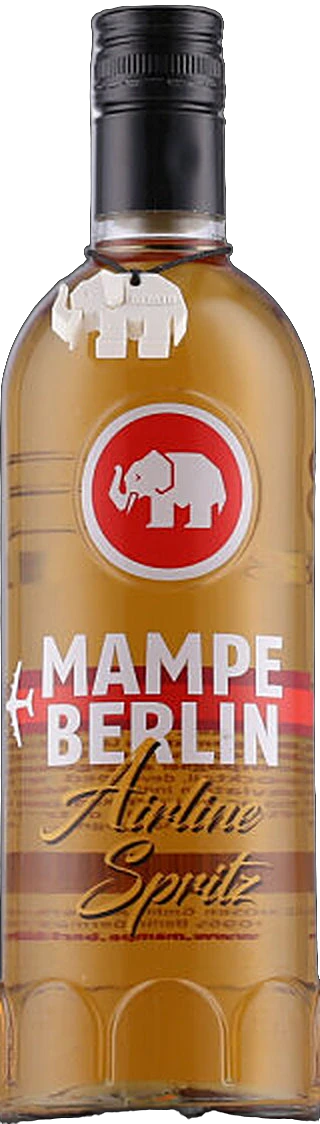
Today's range moves between historical rediscoveries and modern city interpretations. The core is the Mampe Halb und Halb — the herbal liqueur with the white elephant on the label, tart and sweet at the same time, a shot that has been known in Berlin pubs for generations. In addition, there is the peppermint liqueur, gins with Berlin street names like Ku'damm and Kreuzberg 61, an elephant caraway, and the Fliegercocktail — a ready-to-drink spritz that ties in with the Berlin airport myth. The manufactory line appears in black stoneware bottles, the scene line is broader. What all products have in common: they tell the story of a city that makes no fuss about itself, even in its schnapps culture — direct, full of character, and straightforward.