From champagne apprentice to founder of German sparkling wine culture
On July 1, 1826, Georg Christian von Kessler founded Germany's first sparkling wine cellar in Esslingen am Neckar — a date that marks not only company history but German sparkling wine history. Kessler had learned his craft from the ground up: starting in 1807, he worked at the champagne house Veuve Clicquot in Reims, where he rose to become an authorized signatory and member of the management board, contributing significantly to the expansion of the international business. When he was denied the hoped-for takeover of the house, he returned to his native Württemberg — and brought the méthode traditionnelle with him in his luggage.
He opened the business in the former wine press house of the Kaisheimer Pfleghof. The first 4,000 bottles were produced from local Frühburgunder grapes and came onto the market under the simple name "foaming Württemberg wine." By 1829, Kessler was already exporting to Russia, Great Britain, and the USA; in 1881, the house became a Royal Württemberg purveyor to the court. At the 1867 Paris World's Fair, Kessler received a silver medal in the "Vins mousseux" category. After the founder's death in 1842, the Weiss family continued to run the house for six generations — through the phylloxera crisis, world wars, and volatile market conditions. In 2005, Christopher Baur took over the company together with investors and consistently realigned it: back to quality, origin, and artisanal depth.
Medieval cellars, classic craftsmanship, no compromise
The company headquarters and production site is still the historic Speyrer Pfleghof in the old town of Esslingen — a building that, according to tradition, was built around 1213. In its vaulted cellars, the sparkling wines mature according to the méthode traditionnelle: bottle fermentation, subsequent manual riddling on wooden pupitres, and long aging on the lees. Depending on the cuvée, this process takes between 30 and over 60 months. This is not a marketing promise, but the indispensable foundation for the development of aromas that distinguishes Kessler sparkling wines: fine brioche, ripe fruit, depth without heaviness.
The base wines for the range come from deliberately selected sites — including Chardonnay and Pinot Noir from the climatically favored high altitudes of Trentino, and Riesling from the Duke of Württemberg's Monrepos estate. The partnership with the Cavit cooperative winery in Trentino, sealed in 2014, enables direct dialogue with the winegrowers and more influence on the quality of the base wine. Harvesting is done exclusively by hand.
Brut as an attitude — the Kessler range
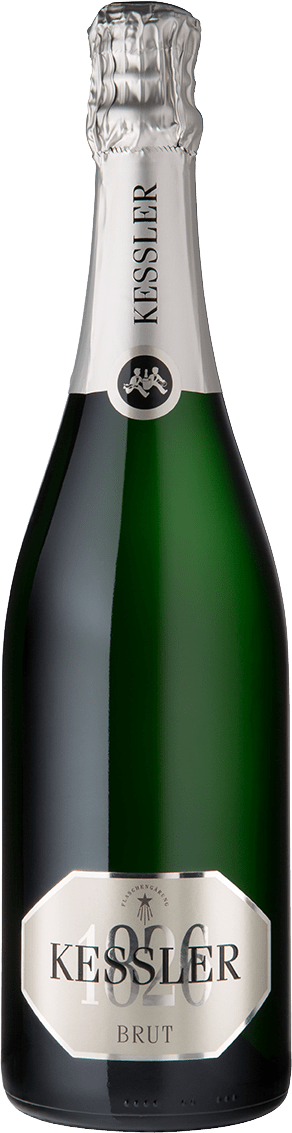
Kessler has always produced its sparkling wines in a dry style. Brut and Extra Brut are not buzzwords here, but a consistent stylistic principle that runs through the entire range. The central entry-level product is the Kessler Brut: a cuvée with fine perlage, lively acidity structure, and the characteristic long finish that only extended aging on the lees can provide. With the Hochgewächs lines — Chardonnay Brut and Rosé Brut — the house focuses on varietal profiles with a clear sense of origin. The Jägergrün Riesling Brut shows what Württemberg Riesling can achieve as a sparkling wine: fruity precision, mineral tension, and a dry aftertaste.
Those looking for the pinnacle of the range will find it in the vintage cuvées — above all the Grande Réserve "Georges," which is disgorged after 60 months of aging on the lees and commemorates the founder who started it all. Aperitif, dinner, or celebration: Kessler makes no compromises on style — you just decide the occasion.