Larry McKenna and the departure to Te Muna
Escarpment Vineyard was founded in 1999 by Larry McKenna and his wife Sue, together with Australian investors Robert and Mem Kirby. McKenna had already secured the property on Te Muna Road, a few kilometers east of the village of Martinborough, in 1998 — as the logical next step in a long career that had put Martinborough on the world map as a Pinot Noir region in the first place. McKenna, trained in Australia and active as a cellar master at Martinborough Vineyard since 1986, had proven there over thirteen vintages that the Wairarapa holds Burgundian ambitions. In 2014, he was inducted into the New Zealand Wine Hall of Fame — as the man who introduced New Zealand to high-quality Pinot Noir. In 2019, the Australian winery Torbreck took over the estate; McKenna remained involved as a consulting cellar master before handing over the reins to the current winemaker Tim Bourne and viticulturist Rowan Hoskins.
Old gravel, cool nights, minimal intervention
The name says it all: An escarpment — a long steep slope at the end of a plateau — literally defines the location. The 24 hectares of vineyards lie on alluvial gravel soils of the Martinborough Terrace, which are over 75,000 years old and were deposited by the Huangarua River. Free drainage, nutrient-poor substrates, hot dry summers, and cool autumn nights slow down ripening and build aromatic depth before the harvest takes place in April. Around 70 percent of the area is planted with Pinot Noir, with the rest accounted for by Chardonnay, Pinot Gris, and Pinot Blanc.
In the cellar, the rule is: as little as possible, as targeted as necessary. Each block is harvested and fermented separately to make the differences between the individual parcels visible. For the Pinot Noir, this means spontaneous fermentation with wild yeasts, whole-bunch portions in many fermentations, hand-plunging of the cap in small open containers — no mechanical pumping. After pressing, the wines mature for 11 to 18 months in French oak barrels, typically with 25 to 35 percent new wood, depending on the wine type and vintage.
Pinot Noir in vineyards named after the starry sky and the ocean
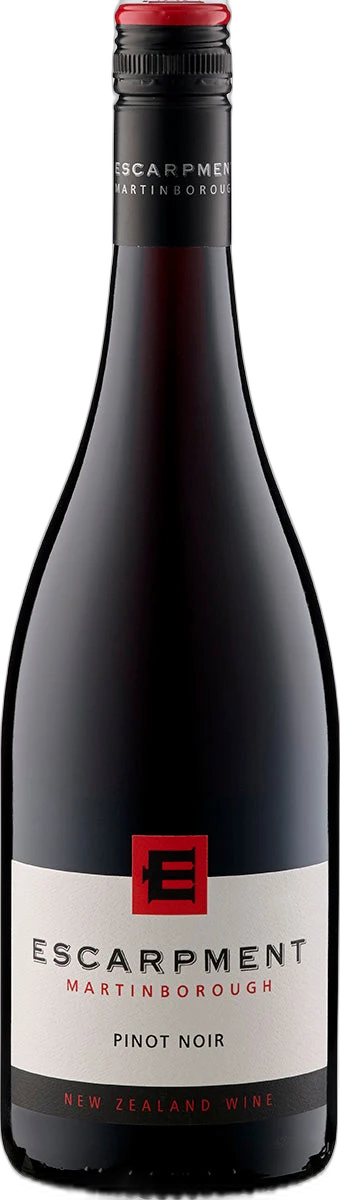
Escarpment works according to a fundamental Burgundian principle: the best parcels are not blended together, but bottled individually and named after their place of origin. The four single-vineyard Pinot Noirs bear names from the Māori tradition — a reference to the Polynesian navigator Kupe, whose legend is linked to the Aorangi Ranges directly above the vineyard. Kupe is the flagship wine, named after the explorer who, according to Māori tradition, first set foot on Aotearoa New Zealand. Kiwa stands for the ocean, Pahi for the Polynesian outrigger canoe, Te Rehua for the star Antares — a navigation point in the southern starry sky. Below this ranks the Escarpment Pinot Noir, a cuvée from several Te Muna parcels with a classic savory character, as well as the Chardonnay, which sets Burgundian standards with taut acidity and mineral depth. The range shows how a terroir becomes readable on different levels — from the accessible entry-level wine to the complex single-vineyard Pinot, which demands structure and fruit in equal measure.