From stud farm to winery: The history of the Waibel family
Constantia Glen is one of the youngest, yet also one of the most insightful chapters in the oldest wine region of South Africa. The story begins with Manfred Thurnher, the grandfather of the current owners: the Austrian textile entrepreneur from Dornbirn acquired the estate in the middle of the 20th century. The family – now known by the name Waibel – initially used the land as a stud farm for Red Angus cattle. The decisive turning point came in January 2000, when a devastating bushfire destroyed large parts of the vegetation and forced the evacuation of the herd. Dieter Waibel and his son Alexander used the break: they decided to return the estate to its original purpose and grow wine. In September 2000, the first vines were planted. In 2005, the first Sauvignon Blancs were bottled, and in 2007, the own winery followed with the first red wine vintage. The family name Waibel has stood for the winery ever since – with Alexander Waibel as managing director and the face of the operation to the outside world.
Terroir as an obligation: Vineyard, cellar, and cultivation philosophy
Before the first vine went into the ground, the Waibels had up to 160 soil profiles analyzed to a depth of up to three meters – to understand which clones thrive best on which site. The result: a 60-hectare estate, 29 hectares of which are planted, at an altitude of 130 to 270 meters at the northern end of the Constantia Valley. The saddle between Table Mountain and Constantiaberg provides the vineyards with afternoon sun that the rest of the valley has already lost – a decisive advantage for the late-ripening Bordeaux red varieties. Cold air from the Atlantic regulates the average annual temperature to around 16 °C; the rainfall is sufficient, so no irrigation is necessary.
The dominant soils of weathered granite and Table Mountain sandstone give the wines their mineral character. Clay-rich sublayers store water and enable dry farming without additional irrigation. In the vineyard, Constantia Glen relies on biological pest control through natural predators. In the cellar, a pure gravity system was consistently implemented: from the harvested grapes to the sorting station to the fermentation tank, everything moves without a pump – except during fermentation. Hand-picking on the rolling slopes of Constantiaberg is not a tradition for its own sake, but a necessary prerequisite for the selective berry picking that winemaker Justin van Wyk has continued in the cellar since 2011. Van Wyk, trained at the University of Stellenbosch, was named Diners Club Winemaker of the Year in 2021.
Bordeaux style at the Cape: a clear range with four wines
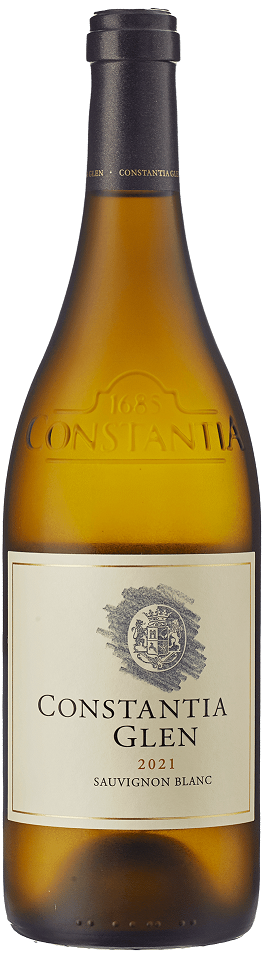
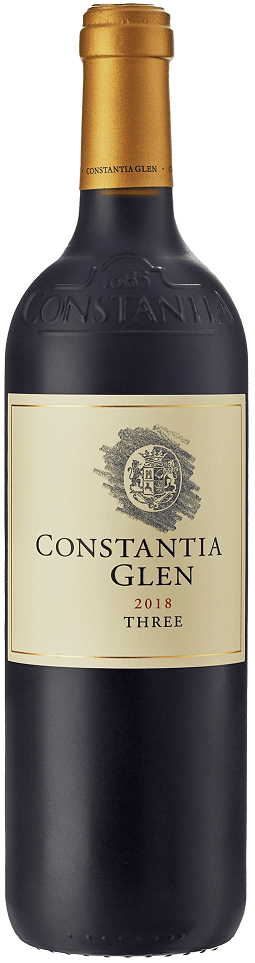
Constantia Glen produces exactly four wines – exclusively from its own grapes, vinified and bottled in its own cellar, limited to 120,000 bottles per year. On the white side are the single-varietal Sauvignon Blanc and the Two, a cuvée with Sémillon. Both benefit from the cool microclimate and show the freshness typical of Constantia with a pronounced acid structure. The red wines are oriented toward Bordeaux: The Three is Merlot-dominated with Cabernet Franc and Cabernet Sauvignon – more accessible, fruit-forward. The Five brings together all five classic Bordeaux varieties led by Cabernet Sauvignon and is aimed at drinkers looking for structure and depth. Cabernet Franc plays a supporting role in both cuvées and, according to Alexander Waibel, is a conscious stylistic decision. The red wines mature in French oak barrels of various origins. Access to afternoon sun in the saddle between the mountains allows for complete phenolic ripeness of the reds without losing freshness – the balance of fruit, tannin structure, and acidity that distinguishes Constantia Glen from warmer regions of South Africa. Serving temperature for the whites: 9–11 °C, for the reds: 16–18 °C.