From the sugarcane field at the volcano to a global brand: the history of the Pellas family
The roots of the Compañía Licorera de Nicaragua date back to 1890, when Francisco Alfredo Pellas Canessa, originally from Genoa, founded an agro-industrial estate with a distillery at the foot of the San Cristóbal volcano in Chichigalpa, about 120 kilometers from Managua. Initially, the rum was celebrated primarily internally—as a harvest schnapps for the staff of the San Antonio sugarcane estate. It was not until 1937 that the Pellas family first brought the rum to market commercially under the name Flor de Caña, which means "sugarcane flower" in German. Since those beginnings, the family has run the company for five consecutive generations, today under the leadership of Carlos Pellas Chamorro.
In the 1950s, the distillery began systematically aging its rum in white oak barrels—a step that set Flor de Caña apart from the regional competition. From 1959, the first exports to Venezuela, Costa Rica, and other Central American countries were initiated; a few decades later, the brand was present on the global market. The political turmoil of the 1970s and 1980s in Nicaragua paradoxically led to large quantities of long-aged rum remaining in stock—an involuntarily built-up treasure that later strengthened the brand's quality position.
Distillery, craftsmanship, and an attitude that lasts longer than marketing promises
The distillery in Chichigalpa is located just eight kilometers from the crater of San Cristóbal, the most active and highest volcano in Nicaragua. The volcanic soils around the facility are mineral-rich; the groundwater that feeds the fermentation is filtered through underground rock layers. Flor de Caña is a single-estate rum: raw material extraction, fermentation, distillation, barrel aging, and bottling take place exclusively on the company's own premises. Aging takes place in ex-bourbon white oak barrels that stand in the original warehouses without air conditioning and without artificial ventilation—the tropical temperatures and humidity of Nicaragua do the work.
In 2018, Flor de Caña received Fair Trade certification from Fair Trade USA, which confirms compliance with over 300 labor, social, and environmental standards along the entire supply chain. In 2020, Carbon Neutral certification followed from the Carbon Trust (UK)—as the world's first spirit to carry both seals simultaneously. The energy for distillation comes 100% from renewable biomass-based sources; all CO₂ emissions generated during fermentation are captured and recycled. Since 2005, the brand has planted 50,000 trees annually—more than a million trees have been planted to date. The social commitment goes far back into the company's history: as early as 1913, the family founded its own school for employees' children, and in 1958, a company-owned hospital was added.
Aging in the heat of the volcano: what makes Flor de Caña special in the glass
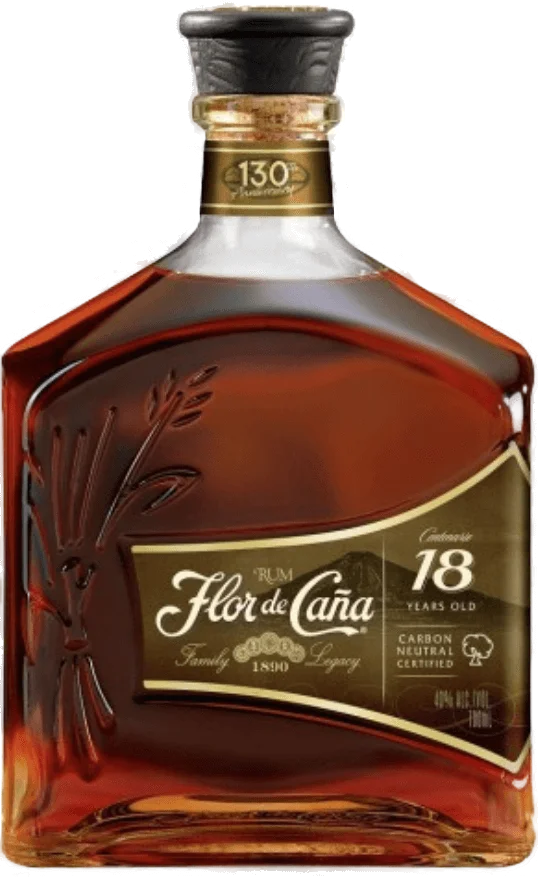
The range at Vinoscout includes three aged expressions. The Flor de Caña 12 Years Old shows a profile of vanilla, caramel, and dried fruits with a soft, round structure after twelve years of barrel aging—an accessible entry into Nicaraguan aging, neat or on ice. The Flor de Caña Terra 15 Years Old adds a denser, spicier layer of wood spices and dark dried fruit with fifteen years of aging; it is suitable as a digestif or in a classic Old Fashioned. The Flor de Caña Centenario Gold 18 Years Old marks the pinnacle of the house: eighteen years in the heat of Nicaragua result in a rum with pronounced oak and date complexity, a long finish, and that depth usually found more in long whisky barrel aging. Neat, at room temperature—without ice.