From the battlefield to Cinquième Cru: six centuries of Batailley
The name says it all: Batailley is derived from one of the decisive battles of the Hundred Years' War, which took place on this soil in 1453. At that time, French troops recaptured the neighboring Château Latour from the English — a moment that signaled the end of three hundred years of British rule in Aquitaine. The first vines were planted on this historic terrain in the 17th century. In 1816, the renowned Bordeaux négociant house Barton & Guestier acquired the estate and expanded the vineyard with new plots in the neighborhood of Grand-Puy Lacoste and Lynch-Bages. The château's park dates back to 1850 and was designed by Barillet-Deschamps, the landscape architect of Napoleon III. Five years later, at the great Bordeaux Classification of 1855, Batailley was awarded the rank of Cinquième Cru Classé.
In 1932, the brothers Francis and Marcel Borie, négociants from the Corrèze, took over the winery from the Halphen family. In the 1940s, they divided the property: Marcel Borie kept Château Batailley, while the separated part embarked on an independent path as Château Haut-Batailley. Today, Philippe Castéja, grandson of Marcel Borie and head of the family house Borie-Manoux, manages the château together with his son Frédéric in the next generation.
Plot by plot: precision in the vineyard and in the cellar
The vineyard mosaic of Château Batailley extends over about 57 hectares at the southern end of the Pauillac appellation. The soil consists of deeply layered gravel over a subsoil of clay and limestone — classic Médoc terroir that consistently favors Cabernet Sauvignon. The planting reflects this: 70% Cabernet Sauvignon, 25% Merlot, 3% Cabernet Franc, and 2% Petit Verdot. The average vine density is 8,000 vines per hectare, and the average age of the vines is around 40 years. Harvesting is done exclusively by hand.
In the cellar, a system of about 60 temperature-controlled stainless steel tanks — one for each plot — allows for plot-by-plot vinification. Fermentation follows traditional lines; a short cold maceration is followed by alcoholic fermentation, and malolactic fermentation takes place in the tank. The wine then matures for 16 to 18 months in 225-liter French oak barriques (55% new). In the vineyard, Batailley completely avoids herbicides; since 2005 and 2010 respectively, treatment rhythms have been oriented toward lunar cycles, and biodynamic methods are being tested on an experimental area of five hectares.
Classic Pauillac character with depth and consistency
What distinguishes Château Batailley from many of its Médoc neighbors is the reliability of its style over the decades. Cassis, black cherry, graphite, and tobacco — accompanied by firm, well-integrated tannins and a clear structure that gives the wines support and contour without closing them off. In the best vintages, cedar wood and a hint of mint are added, shifting the profile toward classic Pauillac complexity. Over the last two decades, the team has further refined fruit precision without abandoning the estate's fundamental character.
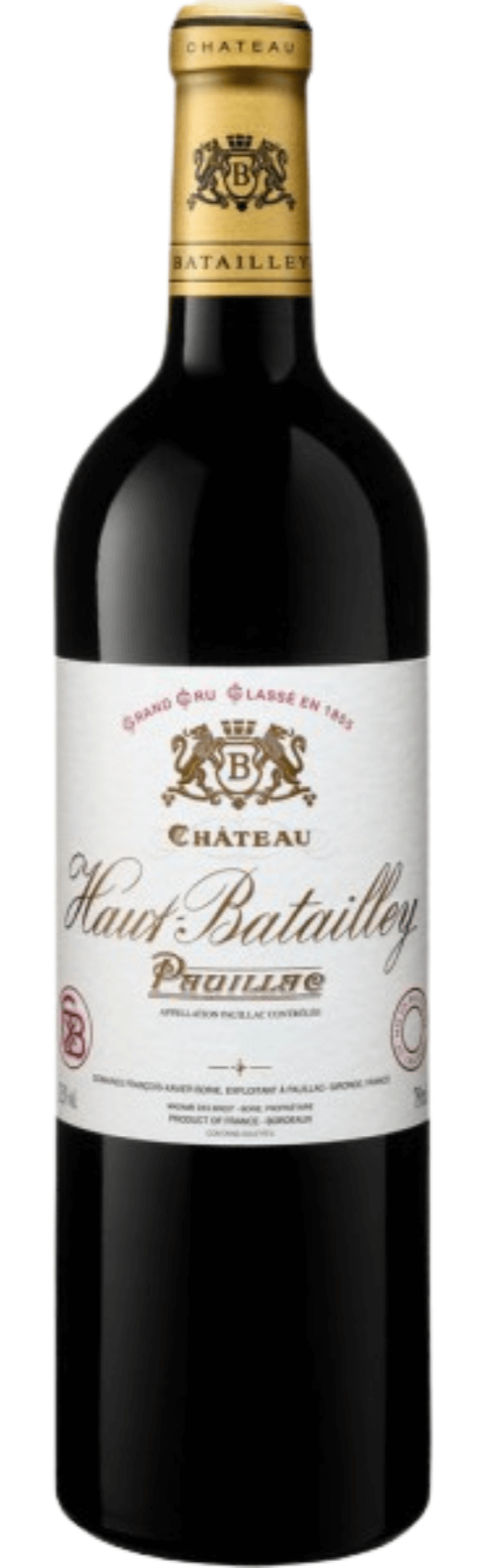
In addition to the Grand Vin, the Château Batailley range has included Lions de Batailley as a second wine from younger vines since 2014. Château Haut-Batailley, available in the Vinoscout shop — now owned by the Cazes family — comes from the separated part of the original estate and shares its origin from the same historic soil. Both wines are classic companions to rack of lamb, duck breast, or aged hard cheese — Pauillac at its most honest.